
By Howard Gorrell
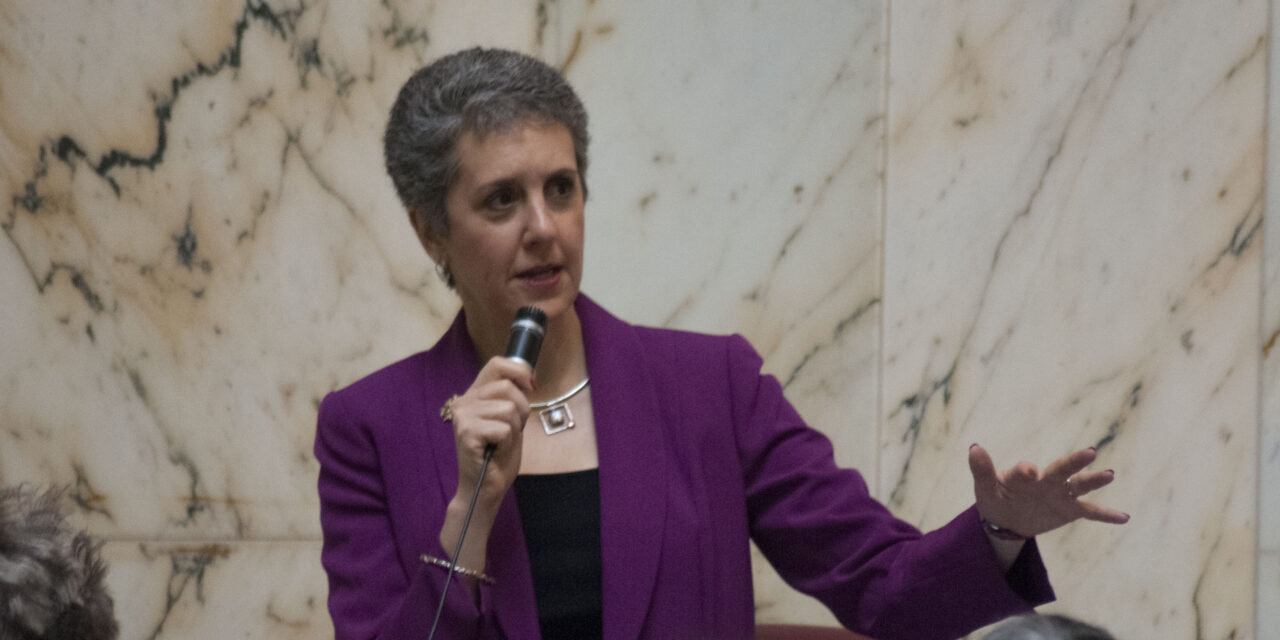
While Fight Back MD supports a “YES” vote and Protect Maryland Votes urges a “NO” on the November 2026 congressional redistricting amendment (Question 3), respectively, Sen. Cheryl Kagan, D, of Montgomery County has led efforts to make ballot questions easier to understand. Here is a timeline of her six-year campaign for plain-language legislation:
- SB 56 (2020 Legislative Session): This was her first attempt to require ballot questions to be written at a 6th-grade reading level or lower. (Status: Died in the House).
- SB 495 (2024 Legislative Session): She reintroduced the idea as the “Simplified Ballot Language” bill, which sought to remove confusing legal terms from ballot measures. (Status: The bill passed the Senate but did not advance in the House Ways & Means Committee.)
- SB 615 (2025 Legislative Session): She continued her efforts by proposing a bill that would require clear titles, plain-language descriptions, and straightforward explanations of what a “yes” or “no” vote means. (Status: The bill was carried over and modified.)
- SB 29 (2026 Legislative Session): This was her final, successful version of the bill, titled “Election Law – Petitions and Ballot Questions – Contents, Plain Language Requirement, and Procedures.” (Status: Gov. Wes Moore signed it into law as Chapter 439.)
Chapter 439 does not specify a reading grade level, but it requires ballot questions and petition summaries to use plain language. The law aligns with the federal Plain Writing Act of 2010, which typically aims for an 8th-grade reading level or lower.
On January 21, Sen. Kagan addressed the Senate Education, Energy, and the Environment Committee regarding the proposed SB29 bill and highlighted the following points:
- Ballot questions often use confusing and technical language.
- In 2022, voters saw five statewide ballot measures written at an average Flesch-Kincaid Grade Level (FKGL) of 14, which is about college-level reading.
- When ballot questions use complex legal language, many voters choose to skip them.
- According to State Board of Elections data, almost 400,000 Marylanders left important ballot questions blank, even though over 2 million people voted for Governor.
Rachel London, Executive Director of the Maryland Developmental Disabilities Council, was the next witness. She reminded the committee of the following points:
- This bill will make voting easier for people with disabilities. Voting is a basic right for Marylanders with developmental disabilities, but they still face obstacles. The U.S. Election Commission found that 20% of voters with disabilities have trouble voting, compared to 6% of voters without disabilities. These problems can be solved.
Sara Westrick, Advocacy Director at AARP Maryland, also spoke to the Committee:
- The bill tells the State Board of Elections to follow the Plain Writing Act of 2010 and use federal guidelines that help voters with different reading abilities and disabilities.
Jonathan Rondeau, President and CEO of Fello, an organization that supports people with disabilities, testified next.
- SB29 will make ballot measures easier for all voters to access and understand, including those with disabilities.
After Kagan spoke to the House Government, Labor, and Elections Committee on April 1, Braden Stinaer, a staff attorney at Disability Rights Maryland, also addressed the committee.
- A 2023 analysis conducted by Ballotpedia found that many ballot measures require a graduate-level reading ability to understand. This level of complexity can pose challenges for the average voter and creates particular barriers for individuals with many disabilities, including those with intellectual disabilities and those who experience cognitive symptoms.
If I spoke to either committee, I would highlight this key point:
- Several studies show that the average reading level among people in the deaf community is between the 4th and 5th grades.
Eight ballot questions appeared in the last three even-numbered election years: 2020, 2022, and 2024. Using the Flesch-Kincaid Calculator, I found that the average grade level for these eight questions was 14.1, which matches Kagan’s claim.
I used a calculator to review the November 3 ballot questions from the State Board of Elections. The FKGL scores were extremely high: 29.5 for Question 1, 18.8 for Question 2, and 33.8 for Question 3, with an average of 27.4.
On July 31, Kagan told Bethesda Today that the wording of Montgomery County Question A might violate her plain-language law. Ultimately, the question was removed from the November 2026 ballot because it lacked sufficient valid petition signatures.
Since the August special session, Kagan’s only public comment was an Aug. 26 statement to WBAL-TV 11. In it, she defended the legislation’s wording as ‘carefully considered’ by the attorney general and others.
To keep Question 3 on the ballot, the Maryland Supreme Court ordered a rewrite on Sept. 3. The new text scored 33.7, just 0.1 point higher than the original.
A high FKGL score of 33.7 indicates that Question 3 remains difficult for most readers and for voters with disabilities.


Recent Comments