
By Howard Gorrell
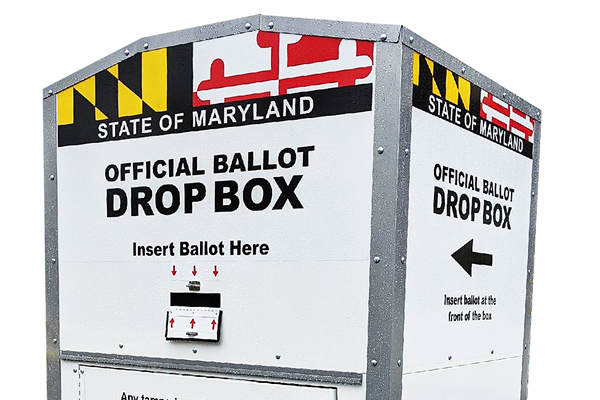
On Thursday, the Supreme Court of Maryland approved a proposed amendment on congressional redistricting for the November ballot. This decision reversed two lower-court rulings that would have blocked it. The Court decided that Question 3 will remain on the November 2026 general election ballot and instructed the State Board of Elections to update the text of Question 3, which now says:
“FOR the purpose of clarifying that certain requirements apply only to districts for the election of members of the Senate of Maryland and the House of Delegates; authorizing the General Assembly to grant original jurisdiction to the Supreme Court of Maryland to review the congressional districting plan of the State; and providing that nothing in the Maryland Constitution provides applicable criteria for the boundaries of a congressional districting plan.”
This version differs slightly from the ballot question text the General Assembly approved. That version said
“The proposed Constitutional Amendment clarifies that certain standards in the Maryland Constitution apply only to districts used to elect members of the General Assembly; authorizes the General Assembly to grant original jurisdiction to the Supreme Court of Maryland to review the congressional districting plan of the State; and requires the criteria for boundaries of congressional districts to be determined by applicable federal laws.”
I am surprised and confused that the Supreme Court’s opinion did not mention SB0029, titled “Election Law – Petitions and Ballot Questions – Contents, Plain Language Requirement, and Procedures.” Gov. Wes Moore signed it into law last May.
The new law requires the State Board of Elections to make sure ballot question summaries use plain language. These summaries must follow guidelines from the federal Plain Writing Act of 2010, which usually sets the standard at an 8th-grade reading level or lower. They also need to avoid passive voice, legal jargon, and double negatives.
Some states use the Flesch-Kincaid readability formula to measure how easy a text is to read.
The Flesch-Kincaid Grade Level (FKGL) for the Supreme Court’s text, excluding the “yes” or “no” vote explanation, is about 33.5, indicating it’s written at a graduate-level college, which is too complex for most voters.
Interpretation of the Flesch Reading Ease Score (FRES) and Flesch-Kincaid Grade Level (FKGL) | ResearchGate
This score is even higher than the General Assembly’s text, which has an FKGL of 32.2.
In this November’s election, voters will see three statewide ballot questions. Question 3 is one of them.
Question 1 (Arbitration Reform for State Employees Act of 2026) has a FKGL score of 29.5.
Question 2 (Temporary Appointments on the Commission on Judicial Disabilities) has a FKGL score of 18.
The average FKGL for all three questions is about 27, which is still at the college graduate level. This appears to conflict with Election Law Article § 7-103(b)(4)(1), which says voters should be able to understand a ballot question easily.
In January, Sen. Cheryl Kagan, D-Montgomery, introduced SB0029 to ensure that ballot questions and petition summaries are written in clear, plain language.
At committee hearings, Sen. Kagan noted that in the 2022 elections, Maryland’s five statewide ballot measures had an average Flesch-Kincaid reading level of college (Grade 14). She also pointed out that about 10% of Maryland adults do not have a high school diploma
Because of technical and legal jargon, almost 400,000 Marylanders skipped the ballot questions in 2022, even though they still voted for governor.
[The FKGL results for the 2022 Questions were: Question 1 at 15, Question 2 at 17, Question 3 at 14, Question 4 at 14, and Question 5 at 12. The 2022 average was 14.4, while the 2026 average was shockingly high at 27.]
SB0029 has Two Main Parts:
Plain Language Mandate: Ballot questions, their explanations, and petition summaries must be written in clear, easy-to-understand language.
Practical Impact Explanations: Ballot descriptions must explain what happens if you vote “yes” or “no,” so voters know what their choices mean.
The Supreme Court’s text explains “yes” and “no” votes as follows:
- For the Constitutional Amendment
- Against the Constitutional Amendment
At Thursday’s hearing, Supreme Court Justice Shirley Watts asked, “Are you at least willing to admit that the third clause of this question, as worded, is quite ambiguous?” She also asked, “Where is that? Where are the voters? Where is that explained?”
What a “yes” or “no” vote means
Both Questions 1 and 2 include “yes” and “no” explanations.
Del. Bill Wivell, R-Washington and Frederick, told Tristate Alert that he suggested the following for Question 3, which gives a more direct explanation of the choices:
- “Yes” gives Maryland lawmakers greater freedom to draw congressional districts as they wish — even in unusual shapes that don’t follow natural boundaries. State legislative districts are unaffected.
- “No” keeps the current rule in place: congressional districts must be compact and connected, and drawn so they make sense on a map, not stretched or carved up to favor one party. That’s the same standard a Maryland court used in 2022 to strike down an earlier congressional map as an unconstitutional gerrymander.
Finally, the FKGL score for Wivell’s suggestion is 12.1, which matches a 12th-grade reading level (high school senior).
On August 26, Kagan told WBAL-TV 11 News, “The wording of the proposed legislation was carefully considered by the attorney general and others.”
Why haven’t the Attorney General, the Secretary of State, and the Supreme Court followed Election Law Article § 7-103(b)(6), which says there must be a short statement explaining what each voting choice for Question 3 means, so voters can clearly understand their options?



The Supreme Court majority is doing what the dominant party wants, rather than do its proper judicial duty.