
By Howard Lee Gorrell
Maryland legislators will return to Annapolis for a three-day special session next week. They will consider a constitutional amendment that could affect congressional redistricting for the 2028 and 2030 elections after the U.S. Supreme Court’s decision in Louisiana v. Callais weakened Section 2 of the Voting Rights Act of 1965.
- Step 1: Legislators must pass the proposed constitutional amendment during the special session. This redistricting effort requires a three-fifths vote in both the Senate and the House.
- Step 2: If the legislature passes the amendment, it goes directly onto the ballot this November for Maryland voters to approve or reject.
- Step 3: If voters approve the amendment, the state will have legal authority to redraw congressional maps during the 2027 Maryland General Assembly session, ahead of the 2028 election cycle.
- Step 4: Gov. Wes Moore will likely re-establish the Governor’s Redistricting Advisory Commission (GRAC) to explore redrawing the state’s congressional maps.
- Step 5: The GRAC will accept outside proposals and review them for mapping and redistricting.
Imagine the new GRAC members reviewing one unusual proposal: a Deaf Congressional District. The main point is that it can be drawn.
First, no federal law bans partisan gerrymandering. Because of the U.S. Supreme Court’s 2019 decision in Rucho v. Common Cause, which ruled that partisan gerrymandering is a “political question” beyond federal courts’ reach, Maryland can redraw the map as it chooses. Remember, the Maryland redistricting case, Lamone v. Benisek, is consolidated with the Rucho case, which sparked the Mid-Decade Redistricting War.
Secondly, the Callais decision does not require Maryland to draw a map that protects any racial group—black or white.
Thirdly, the Maryland Constitution is silent on the Core Redistricting Standards: Equal population, Compactness, Communities of Interest, and Contiguity, when drawing congressional district maps.
Fourth, the districts must be equal in population.
Therefore, this Deaf Congressional District proposal meets the first three standards, but not the fourth.
Deaf missing in Congress
No culturally Deaf individual has ever served as a U.S. Senator or U.S. Representative in the history of the United States Congress. “Culturally Deaf” refers to someone who actively participates in the Deaf community and embraces Deaf culture.
Most Deaf communities know that, in the presence of his culturally Deaf brother, Frank, U.S. Senator Tom Harkin (Iowa) delivered the first-ever speech on the Senate floor in American Sign Language, telling Senators about the passage of the Americans with Disabilities Act on July 13, 1990.
Aiming to become the nation’s first Deaf congressman, Howard Rosenblum, former CEO of the National Association of the Deaf, launched his campaign for the 2026 Democratic primary in Illinois’ 9th Congressional District, a heavily gerrymandered district. He paused his campaign on January 30th amid a crowded field of 16 Democratic candidates.
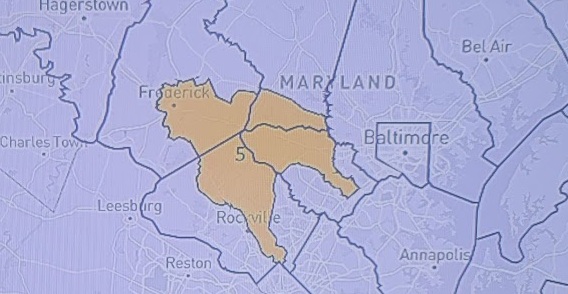
In recent weeks, I emailed Deaf state leaders to seek their perspectives on the congressional district proposal. Many leaders said a unified Deaf district would enhance representation, civic engagement, and access to resources. Based on this feedback, I propose one congressional district centered on Deaf communities, with the GRAC drawing seven other districts to ensure equal populations.
The map lines should focus on three target areas where most of the culturally Deaf population resides: Frederick, home to the Maryland School for the Deaf’s Frederick campus; Ellicott City, home to the Maryland School for the Deaf’s Columbia campus; and Silver Spring, home to the National Association of the Deaf.
As a result, its deviation from the ideal population of 771,925 is -0.0%, or 4 fewer residents. Based on the 2020 Census Voting Age Population, this proposed district’s population is 580,507, with 49.33% Caucasian and 50.67% Minority.
Based on the Election Results (2016 President, 2020 President, 2016 Senate, 2018 Senate, 2018 Governor, 2018 Attorney General), the district received 63% for the Democratic Party, 33% for Republicans, and 3.25% for others.
The likelihood of creating the Deaf District could be zero. While it would be safely Democratic, the party is seeking a different congressional map that could capture the currently Republican First Congressional District without legal interference.
Howard Lee Gorrell has been a lifelong advocate for the Deaf and a persistent opponent of partisan gerrymandering,




Recent Comments