
Del. Lily Qi’s new memoir “Elected American: From Red China to Blue Maryland” is really two books in one.
 First, it is a recounting of growing up in Communist Shanghai and then, as an adult, the sometimes difficult adjustment to life and work in the U.S.
Secondly, it is a detailed account of what it takes to win an election to the House of Delegates as an immigrant from a community that is not politically conscious.
Fortunately, the memoir goes back and forth between the two stories in short digestible chapters. There is a lot of first-hand literature in English about China in the 1960s, ’70s and ’80s, one of the most traumatic and transformative periods in China’s recent history.
For Americans unfamiliar with this period from a native Chinese point of view, Qi’s accounting is a slice of life under Communist Chairman Mao Zedong and the subsequent great opening to the West by Deng Xiaoping.
Qi (pronounced Chee) and her family’s experience is relatively benign, but it shows how deprived a lifestyle could be for even a household with two working professionals.
Qi is a bright student and manages to pass the most rigorous exams to get into college. She is on her way to a professional career in China, when, at 25, she decides to leave for the United States at the invitation of an American professor from a rural Indiana college, a move that is a cultural shock on many levels for a Shanghai woman.
She makes several moves after that — Ohio, West Virginia and D.C. — mostly in academia and government, and eventually lands in Montgomery County where she becomes an assistant to County Executive Ike Leggett for economic development. It’s a long journey, neither swift nor easy, but one can imagine not uncommon ups and downs for even a well-educated, hard-working Asian immigrant.
Qi’s involvement in politics is a different sort of education and another leap into unfamiliar territory. She must learn the ropes of a political campaign as she balances an outreach to her Chinese community that must be persuaded to vote as Democrats in a closed primary and the Super Dems who question her pro-business credentials.
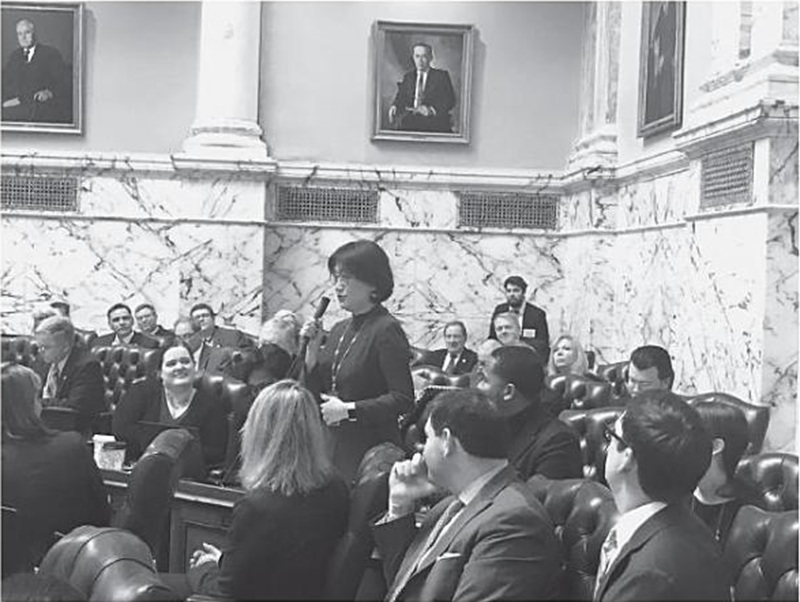
Qi is frank about her views, her mistakes and her internal doubts despite her confident outlook. Given all she has to overcome, the reader begins to wonder how she can win. Obviously she did, since she starts the book with her maiden speech in the House of Delegates Feb. 22, 2019 – George Washington’s birthday and the 30th anniversary of her arrival in the United States.
Halfway through the book, I cheated and looked at the 2018 primary results for District 15. There were nine candidates for three delegate seats and Qi came in second, several hundred votes ahead of one of the two incumbent delegates and thousands of votes more than the other six candidates. In the 2022 primary and last month, she was the top vote-getter.
In the legislature, Qi has been a slightly different Democrat with her emphasis on economic growth, putting her at odds with the anti-business attitude among some of her fellow Democrats. “Before our eyes, we are becoming a second-tier community, with abysmal job-growth and a shrinking tax base, forcing us to raise taxes on existing residents and businesses to pay for what we have taken for granted,” writes Qi. This year she was named chair of the Economic Development Subcommittee of the House Economic Matters Committee.
Over the years, especially when things were not going well financially, Qi would express doubts about her decision to come to the United States. And over these 37 years since she left China, so much has changed in the economic status of the two countries.
“Now each visit to my birth country is a visceral reminder of its speed and ambition, from payment super-apps that make our plastic credit cards and chip-reading machines look like twentieth-century relics to hyper-connected transportation networks that are the envy of the world. America, in contrast, feels paralyzed, mired in partisanship and short-term thinking. Even global cities like New York seem to creak under their own weight, while China’s infrastructure dazzles. It’s not just about gross domestic product. It’s about energy, spirit, and belief in the future. It’s as if we’ve lost the will to do big things and fallen behind the world America invented.”




Over the years, especially when things were not going well financially, Qi would express doubts about her decision to come to the United States. And over these 37 years since she left China, so much has changed in the economic status of the two countries.
If that is the case why not just remain in China on one of her “frequent visits”. Perhaps the reason is as simple as she is exactly where the Chinese government wants her to be fulfilling the role she was funded to fulfill – infiltrating the US politial system to contine the spread of Chinese propaganda such as … “Now each visit to my birth country is a visceral reminder of its speed and ambition, from payment super-apps that make our plastic credit cards and chip-reading machines look like twentieth-century relics to hyper-connected transportation networks that are the envy of the world. America, in contrast, feels paralyzed, mired in partisanship and short-term thinking. There are many in the MoCo Chinese American Community who fell she is in fact an agent for the CCP. It is funny how her story has changed from being a 17 year old pennyless girl who somehow made it to America ( so it was in 2018 when running for office – that was part of her stump speech) to a 25 year old girl of financial means invited by a collage perfessor when there is increased scrutiny on possible CCP operatives.
As for a hard fought political rise in MoCo politics – another fairtale. The facts show that her performance as the BD person under Legget was less than steller and yet at the start of the campaign in ’18 she had over $100,000 in the bank supported by Leggits arm twisting democrat donors. Her book is in fact two tales America needs to be weary of which one are true.