
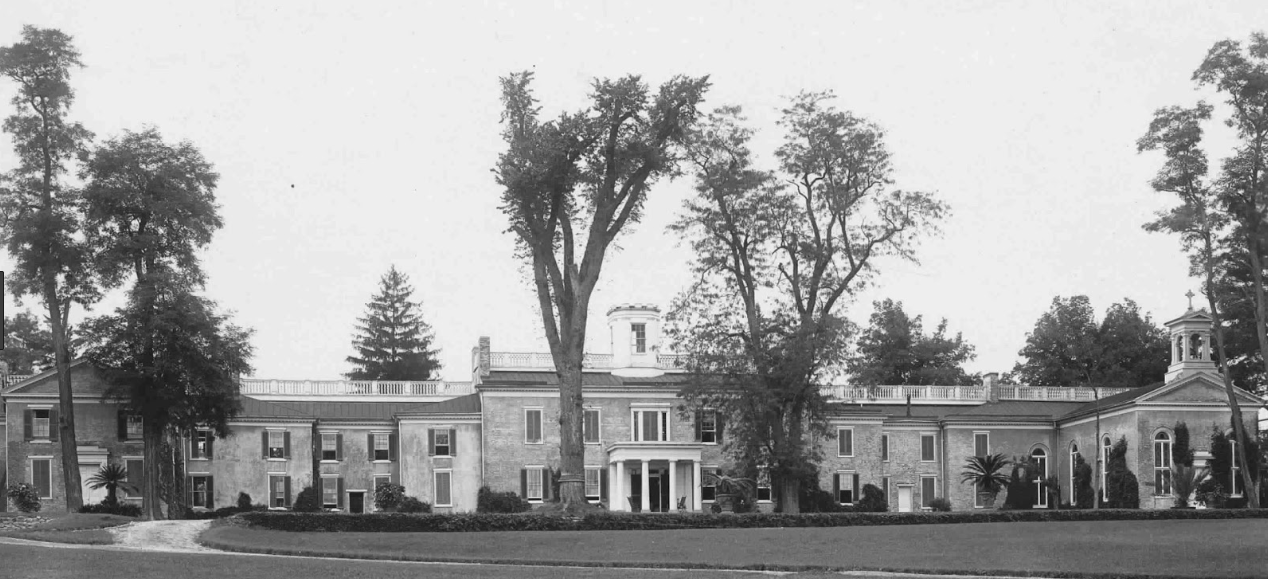
This column appears in the July issue of The Business Monthly serving Howard and Anne Arundel counties.
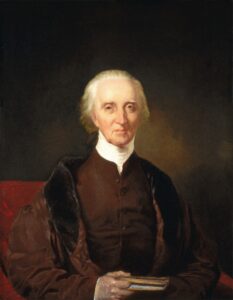
This portrait of Charles Carroll by Chester Harding is in the National Gallery of Art.
In a private Catholic chapel at Doughoregan Manor in Ellicott City lies the body of Charles Carroll of Carrolton who died in 1832 at age 95. He was the last surviving signer of the Declaration of Independence and its only Catholic.
The chapel was built at a time before the revolution when it was illegal to hold public masses, and the law also forbade Catholics from holding public office.
But that did not prevent Carroll from being one of the richest men in the British colonies after his grandfather of the same name first settled in Maryland in 1688. His signature on a document whose most famous line begins “All men are created equal” also did not prevent him from owning as many as 300 enslaved people on his 10,000-acre estate and other properties, probably the largest number of any of the other 40 signers who owned other people.
Thousands of Howard Countians live on land once cleared by these enslaved people, a term now preferred by historians to emphasize their humanity.
Carroll was exceptional in many ways for his day. He was among the best educated of the signers and revolutionaries. His parents had shipped him off to France at age 11 to study in schools run by Jesuits for English Catholic boys. He eventually read law in London, but as a Catholic he was not allowed to practice law.
Despite his wealth, he became active early on in the move to free the colonies. Because of his command of French and his Catholicism, he was part of the American delegation that tried unsuccessfully to persuade the French Canadians in Quebec to join the cause.
When he and the others signed the declaration, there was no guarantee that it would not cost them their property or even their lives. Of course, we now know that part of the story ended well.
Maryland and Marylanders played a central role in the eight-year conflict and its aftermath. Marylander John Hanson was the first “President of the United States in Congress Assembled” under the Articles of Confederation. The treaty ending the war was ratified in Annapolis, where Washington also resigned his commission, establishing civilian control of the military.
From 1781 to 1800, Carroll served in the Maryland Senate. After the new constitution was ratified, in 1789 the legislature appointed him a U.S. senator, but he gave up his federal seat when a new Maryland law said he couldn’t serve in both senates.
Carroll invested in many projects in the new nation, most notably the nation’s first railroad, the Baltimore & Ohio, whose first line ran from Baltimore to Ellicott City, capitalizing on the city’s status as the eastern port closest to the Midwest.
What of his slaves? Slavery “was admitted by all to be a great evil,” he is quoted as saying. He proposed its gradual abolition in the Maryland Senate, but it did not pass. He became part of the movement to send the enslaved “back” to Africa (where most had never lived) but he never freed his own enslaved people.
Like Thomas Jefferson, he was a highly educated, forward-thinking man, but he could not give up one of the key foundations of his wealth. In many ways, Charles Carroll exemplifies the promise and contradictions of the founding fathers.


Recent Comments