
The $132 Million Mirage
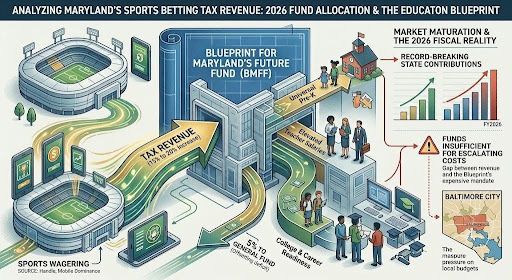
Let’s be real for a second about Maryland’s sports betting boom. Lawmakers will happily parade the record-breaking $132.3 million state contribution from Fiscal Year 2026 around Annapolis. They point to a massive 48.8% year-over-year jump as absolute proof of concept. The reality is quite a bit darker when you peek beneath the hood of that $6.91 billion annual handle. Mobile platforms now control a suffocating 98.4% of the market action. Bettors are not driving to retail casinos anymore; they are tapping screens from their couches. You might think this digital gold rush solved the state’s education funding problems overnight. Frankly, it barely covers the interest.
Squeezing the Books: The 20% Surcharge and Deduction Death
Dive straight into the mechanics of this cash grab to fully understand how the state juiced its returns. Back in 2025, Gov. Wes Moore stared down a terrifying $3.3 billion structural deficit. Politicians needed immediate cash without the political suicide of raising income or property taxes on individual citizens. The obvious target was the sportsbook sector. Consequently, the mobile tax rate jumped from a moderate 15% to a hefty 20%. Physical retail books kept the old rate, largely because keeping the lights on in a massive brick-and-mortar facility carries a level of overhead that digital apps do not face.
That wasn’t the only leverage the state pulled. Regulators severely throttled the promotional deductions that operators traditionally claim against their gross revenues. Early market days saw sportsbooks writing off up to 20% of their revenue in “free play” bonuses just to acquire initial customers. Maryland slammed that door shut, dropping the allowable deduction down to a measly 5%. Operators are now paying hard taxes on money they essentially gave away as marketing collateral. Mega-corporations like FanDuel and DraftKings Sportsbook can easily absorb this aggressive squeeze. These giants just leverage their massive, nationwide promotional budgets to offset the localized tax hit. They treat the Maryland surcharge as a minor cost of doing business, essentially starving out smaller, regional operators who rely desperately on local free-play campaigns to acquire their initial users. This predatory dynamic birthed a rigid duopoly that currently controls nearly 70% of the entire state’s handle.
Volatility remains the true wildcard in this fiscal equation. June 2026 actually saw a nearly 30% spike in total handle compared to the prior year. Yet, the state’s tax yield dropped by 17.4%. Bettors simply had a hot month on the board. The household percentage plummeted from 14.1% to a highly normalized 10.4%, proving that a few bad beats for the books translates instantly to less cash for the state budget. Fortunately for lawmakers, an endless barrage of high-margin, multi-leg parlay wagers kept the aggregate hold rate at a healthy 11.5% for the entire fiscal year. Casual bettors love throwing ten bucks at an eight-leg same-game parlay; sportsbooks love it even more because the mathematical edge on those bets is astronomical.
The General Fund Skim
Follow the money away from the apps and into the state treasury. Voters originally approved the legalization of sports betting under the explicit, widely advertised promise that the money would fund the Blueprint for Maryland’s Future. That noble narrative fractured the exact moment the state realized it was broken. Look closer at the new 20% mobile tax bracket. Lawmakers bifurcated the revenue stream starting in July 2025. The original 15% still funnels directly into the education trust fund. That extra 5%? It gets diverted straight into the state’s unrestricted General Fund.
Just one year of this statutory diversion netted the Moore administration nearly $33 million in discretionary capital. Education advocates might scream about broken promises to the school system. Desperate governments, however, will always raid dedicated trust funds to patch a sinking ship.
The Kirwan Black Hole: When Billions Dwarf Millions
The catch with the Blueprint for Maryland’s Future—originally mapped out by the Kirwan Commission—is its astronomical, compounding price tag. A statutory mandate for $60,000 starting salaries and universal Pre-K sounds fantastic on a glossy campaign brochure. Finding the actual cash to pay for those initiatives is a completely different beast. By 2032, this legislation requires a staggering $3.8 billion in annual, recurring funding.
Do the math on that celebrated $132 million sports betting yield. Tax revenue from wagers currently covers roughly three percent of the Blueprint’s ultimate cost. Legislative analysts are already sounding the alarm that the education fund will cross into a deep, unrecoverable deficit by 2027. State economic models previously suggested that paying for these reforms without gaming cash would require an 89% hike in the sales tax or a 39% bump in personal income taxes. Sports betting is clearly not the savior of Maryland schools; it is a temporary, fractional band-aid slapped over a gaping fiscal wound.
Baltimore Bleeds While Annapolis Counts Chips
Look away from the state ledgers for a minute and head down I-95 to see the real collateral damage hitting the local level. The Blueprint forces county governments and municipalities to shoulder a massive portion of these escalating costs through a strict “Local Share” formula. Baltimore City provides the most brutal, quantifiable case study of this financial crowding-out effect.
Mandatory local contributions to Baltimore City Public Schools skyrocketed by nearly 50% over a four-year period. For FY2026, the city’s General Fund appropriation to the school system hit an unbelievable $410 million. That single line item eats up 17% of the entire municipal budget. Every dollar legally locked into this state-mandated education formula is a dollar stolen from housing rehabilitation, infrastructure repairs, or police funding. Baltimore residents pay the highest property tax rate in the state (2.248%), yet their local government is financially paralyzed by Annapolis’s inflexible mandates. The sports betting boom heavily enriches the central state accounts but does absolutely nothing to offset the obligations crushing local mayors.
Buying Off the Locals and the Addicts
Check the fine print of the original legislation, and you will find a few highly specific equity carve-outs built to appease early skeptics. Lawmakers created the Small, Minority, and Women-Owned Business Sports Wagering Assistance Fund (SWAF) to ensure out-of-state tech giants didn’t completely monopolize the wealth. Five percent of the massive upfront licensing fees—which cost up to $2 million for major stadium casinos—capitalizes this grant program. Local mom-and-pop operations can score up to $50,000 for IT support, security software, or employee regulatory training. It serves as a structural attempt to keep at least a handful of breadcrumbs inside the local entrepreneurial ecosystem.
A 24/7 casino sitting in the pocket of every citizen obviously creates a massive addiction liability. The state combats this via the Maryland Problem Gambling Fund. This account benefits from a rather morbid revenue stream: human absentmindedness. Any winning ticket left uncashed for 182 days expires immediately, and that cash goes straight to addiction treatment, netting over $5.6 million cumulatively by 2026. A recent statutory adjustment now also skims 1% of total gaming proceeds for the fund, guaranteeing roughly $6 million annually for counselors to clean up the collateral damage of mobile wagering.
Chasing the Next Hit
Annapolis is already sweating the 2027 fiscal cliff. The Blueprint’s massive bill is coming due quickly, and the sports betting well is functionally tapped out. Politicians are currently circling the next logical fix: Historical Horse Racing (HHR) machines. These terminals look and play exactly like traditional slot machines. They base their payouts, however, on the algorithms of dead horse races. If voters approve them in November 2026, conservative estimates suggest an eventual $188 million annual boost to the state coffers.
We are watching a desperate, serialized hunt for sin taxes. The eventual push for full online casino gaming (iGaming) is absolutely inevitable at this point. Maryland proved it can efficiently squeeze millions of dollars from digital bookmakers without triggering a massive public revolt. The only problem is that the state designed a luxury vehicle it cannot afford to put gas in. Wagering taxes bought Annapolis a few years of political cover. The harsh reality remains that no amount of digital parlay volume can outrun a four-billion-dollar school mandate when the house finally runs out of chips.


Recent Comments