
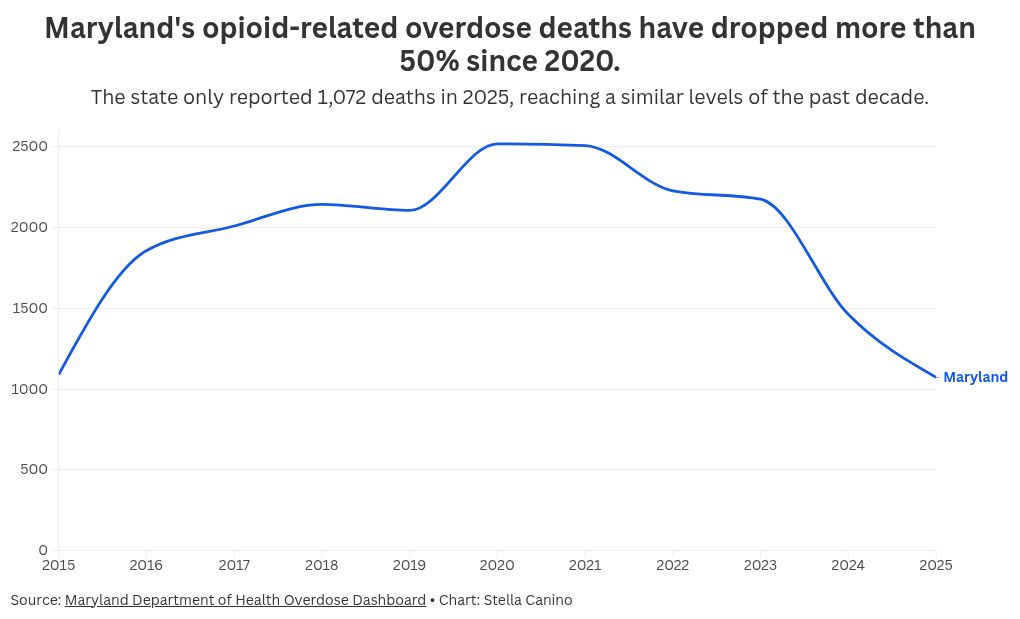
Opioid-related overdose deaths in Maryland have decreased by 57% since an increase during the COVID-19 pandemic, according to a Capital News Service data analysis.
Maryland had over 2,500 opioid-related-overdose deaths in 2020, according to the data. The state’s total for last year was just over 1,000.
The reduction in overdose deaths is the result of a mix of expanded availability of fentanyl test strips, substance abuse treatments and naloxone– a medicine that reverses an opioid overdose– as well as increased funds for affected communities through the Opioid Restitution Fund, according to Maryland health officials.
The state follows a nationwide trend in the decrease of opioid deaths. The United States recorded over 82,000 opioid deaths in 2022, the highest in the past ten years, according to Centers for Disease Control and Prevention provisional data. Opioid deaths were around 45,000 in 2024, a 34% decrease since the nationwide peak.
“Maryland continues to show that our partnerships with local communities are invaluable in our efforts to reduce overdoses across the state,” said Gov. Wes Moore in a January press release about the reduction in overdose deaths. “We have more work to do—but by working together, we will continue to fight for those seeking recovery.”
Most of the state’s opioid overdose fatalities are divided into four categories: opioid-related, prescription opioids, heroin and fentanyl.
Opioid-related deaths count any fatality where at least one opioid — prescribed or not — was involved, including drugs like fentanyl, heroin, oxycodone, codeine and morphine, and may include cases where multiple substances were present, according to the Maryland Department of Health data dashboard.
This category saw a major increase during the pandemic years but over the past few years has returned to similar levels from a decade ago.
Fentanyl and opioid-related deaths have also decreased by 60% and 57%, respectively, since 2020.
Baltimore City has the highest rate of opioid overdose deaths in the country with 103 deaths per 100,000 people, according to 2024 Big Cities Health Coalition data. In comparison, Milwaukee and Cleveland — the next two cities with the highest opioid-overdose death rates — have rates of 63 and 60 per 100,000, respectively.
After years of rising opioid-overdose fatalities, the city’s numbers have started to trend downward since 2023, according to the Capital News data analysis.
Fentanyl deaths peaked at 973 in 2021, but a 52% reduction has occurred over the past four years.
Prince George’s and Baltimore counties were the other two counties in Maryland with the largest numbers of opioid-related overdose deaths in 2025, with 81 and 129, respectively.
Eastern Shore and southern counties had fewer than 10 overdose deaths during that year.
Anne Arundel County had the third-largest number of opioid-related overdose deaths in 2020 with 356. Anne Arundel had a 70% drop in opioid deaths since 2025. In 2020, the county had 226 opioid-related overdoses and last year there were only 69, according to the data.
Prince George’s County had 102 opioid-related overdoses in 2020 and Baltimore County had 356 in 2020.
In 2020, only two counties reported fewer than ten opioid-related overdose deaths, compared with 11 counties last year.
Why have opioid overdose deaths gone down in Maryland?
Maryland’s overdose deaths have declined for the past four years largely because of increased distribution of prevention medication and treatment options, according to Maryland health officials.
“The focus of Maryland Department of Health remains on reinforcing core overdose prevention and education, and drug user health strategies that are effective across an evolving drug supply,” according to a Maryland Department of Health statement sent to Capital News Service. “This includes public awareness and ensuring widespread access to and carrying of naloxone, a medication used to reverse the effects of opioid overdoses.”
Maryland’s distribution of naloxone– also known by its brand name, Narcan– and fentanyl test strips doubled since 2020, according to the MDH Overdose Portal data.
Last year, the state distributed more than 440,000 doses of naloxone and 260,000 drug test strips, the highest on record for the state, according to the statement.
“For us to be able to target that population and provide them access to medications for opioid use disorders really, really helped improve health outcomes in general,” Keller said.
The Good Samaritan Law has played a key role by removing the fear of arrest for people who call for assistance during an overdose emergency, according to the statement. Improved data tools have also allowed healthcare providers, emergency services, law enforcement and community groups to better respond to the drug supply.
Rapid drug analysis helping
Maryland’s Rapid Analysis of Drugs program has also been a standout initiative in which anonymous test samples of syringes, baggies and capsules are tested to reveal what’s actually in the drug supply, Keller said.
This has provided real-time data for health officials, doctors and outreach workers to tailor their responses to what people are being exposed to on the streets, she said.
Local nonprofits and community-based organizations have played a critical role in reducing death during the crisis.
Maryland’s harm reduction strategy relies on these frontline organizations to deliver overdose prevention services, syringe service programs, and naloxone and fentanyl test strip distribution, according to a 2024 study by the National Academy for State Health Policy.
“We have community-based organizations, smaller organizations, that don’t always get a lot of credit because they don’t have the huge names, the huge budgets, but it’s people who care so much and who go out and do the boots-on-the-ground work every single day,” said Keller.
The current opioid crisis started in the 1990s because of overprescription of opioid pain medications, faulty marketing from pharmaceutical companies and weak governmental oversight.
The Opioid Restitution Fund is the central pool where all funds awarded to the state through prescription opioid-related lawsuits are placed, with 70% distributed locally and 30% to support grant programs and state-level initiatives.
In the current fiscal year, $245 million has been received, with a total of $34 million expended, according to the 2025 Maryland Opioid Restitution Fund Expenditure Report.
“In my very humble opinion, it’s about time that they pay for all of the harms that they helped create,” Keller said.
Last week, the state secured more than $90 million in funds from the Purdue Pharma and Sackler family settlement that ended decade-long litigation over the company’s’ and owners’ role in the crisis, according to the office of the Maryland Attorney General.
Another factor may be behind the decrease in nationwide overdose deaths since 2023 with the disruption of the global supply of illegal fentanyl driven by Chinese government actions to crack down on fentanyl precursor chemicals and online marketplaces, according to the American Association for the Advancement of Science Journal 2026 study.
The study found fentanyl powder purity rose to about 25% by weight in early 2023 before falling to roughly 11% by the end of 2024. It also found fentanyl seizures peaked in the first half of 2023 and declined by about 37% by 2024.

Recent Comments