
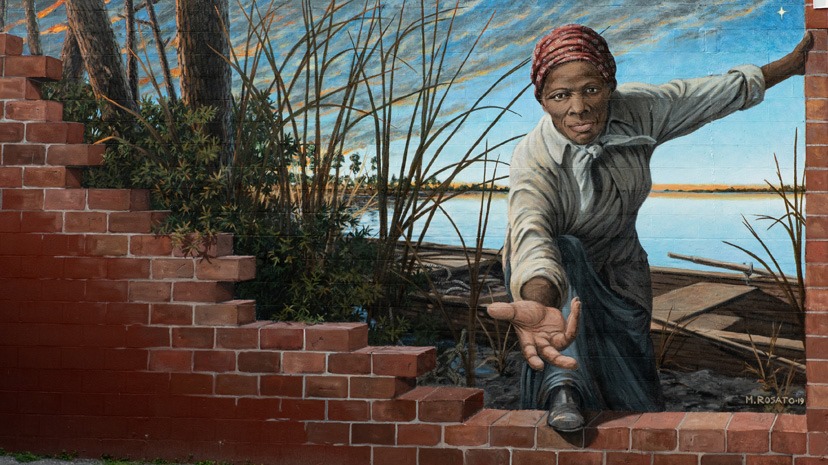
ANNAPOLIS — Maryland advocates, conservationists and museum leaders said they will continue working to preserve the state’s Black history despite what they call federal attempts to dismantle programs.
“If you want to learn how to be a positive agent of change, I don’t care what your walk of life is, learn about Black history,” said Chanel C. Johnson, executive director of the Maryland Commission on African American History and Culture (MCAAHC) and the Banneker-Douglass-Tubman Museum. “Sometimes, it’s just learning about the Black history in your own local community … That is incredibly empowering.”
Local and state organizations have helped protect historically significant sites, created a commission to study lynching and awarded grants, including one to launch a forensic investigation. Organizations have also fought to restore federal funds for a museum focused on Black history, and just last week Maryland congressional lawmakers introduced legislation to create a national council to preserve African American history and culture.
Advocates said the continued fight to protect Black history across the state comes in the wake of efforts to eliminate it in other places.
“There’s been a growing sense of urgency that we cannot ignore what is going on in the federal arena because it impacts us all,” Johnson said. “We’re all in it. None of us are safe.”
Fighting federal efforts
In 2025, a Black Lives Matter mural in Washington, D.C., was ripped up after pressure from Republican congressional lawmakers to remove it. The National Parks Service briefly removed a photograph of abolitionist and Maryland native Harriet Tubman and mentions of slavery from its Underground Railroad website. President Donald Trump issued executive orders ending federal diversity, equity and inclusion policies and challenging some exhibits at the National Museum of African American History and Culture.
“Over the past decade, Americans have witnessed a concerted and widespread effort to rewrite our Nation’s history, replacing objective facts with a distorted narrative driven by ideology rather than truth,” Trump wrote in an executive order last March.
The City of Philadelphia recently sued the National Parks Service for removing an exhibit on slavery at a historical park site last month. A federal judge ordered the exhibit restored.
Maryland’s fight to preserve Black history and culture has been underway for years.
In 2019, state lawmakers passed legislation establishing the Maryland Lynching Truth and Reconciliation Commission, the first statewide, government-backed commission investigating lynching in the nation.
The committee delivered its final report in December 2025, acknowledging 38 lynchings that occurred between 1854 and 1933.
“I’m proud of a lot of what Maryland has done,” said David Armenti, vice president of education and engagement at the nonprofit Maryland Center for History and Culture, who served on the commission. “The boldness to even pass legislation that has those words in it shows you what kind of commitment a state and certain legislators and representatives would have toward truth-telling and not shying away from difficult conversations or ones that are going to call out historical wrongs.”
In February, Sen. Angela Alsobrooks, D-Md., and Rep. Kweisi Mfume, D-Baltimore, introduced a bill to establish a National Council on African American History and Culture. The council would recommend ways to boost federal support for “the preservation and celebration’’ of African American history and culture.
“African American History is American history, and it is both our duty and responsibility as a nation to conserve and protect it,” Mfume said in a statement. “The empowering and liberating story of Black people in this country—woven into the founding of this country—is amidst a series of attacks from the Trump administration and is at risk of erasure.”
Johnson, the museum director, said when the federal Department of Government Efficiency rescinded a congressional grant from the Institute of Museum and Library Services for the Banneker-Douglass-Tubman Museum in 2025, the State’s Attorney Office reached out to the museum and helped it write an affidavit that eventually recovered the funds.
“When we stand together and we hold the line, change can happen,” Johnson said.
Building local bonds
Organizations have created coalitions to share information and strategies partly because of a growing sense of urgency, according to Johnson.
In January, the African American Heritage Preservation Program, a joint collaboration between MCAAHC and the Maryland Historical Trust, awarded $5 million in grants to 29 organizations working on the “acquisition, construction, or improvement of sites related to African American heritage.”
One recipient, the Maryland Department of Juvenile Services, was awarded $200,000 to investigate a gravesite at a once segregated boarding school in Cheltenham. Maryland lawmakers have introduced a bill to investigate the deaths of hundreds of Black boys there, Capital News Service reported.
“In the moment of time that we are in, historically, nationally [and] in our state, I think it’s a great opportunity for us to capture and embrace this tragic history and to teach it,” Sen. William Smith Jr., D-Montgomery, who introduced the bill, said at a hearing Wednesday.
In another effort, the Maryland Department of Natural Resources partnered with the Conservation Fund, a national land conservation organization, to protect land where Tubman’s childhood home was located.
Bill Crouch, the Conservation Fund’s Maryland state director, said that was important.
“It’s almost like we’re writing a story, and it’s chapter by chapter,” he said. “Through land conservation we are telling the story, and that’s pretty powerful.”
The groups continue to work on projects in Maryland, including protecting the 28,300-acre Harriet Tubman Rural Legacy Area in Dorchester County.
“These are stories that need to be told, especially now,” Crouch said.
Alexander Taylor contributed to this report.

Recent Comments