
By Anastasia Merkulova
Capital News Service
Just by flushing their toilets, almost 2 million residents across Montgomery and Prince George’s counties may reduce greenhouse gas emissions and contribute to cleaner air in the national capital region.
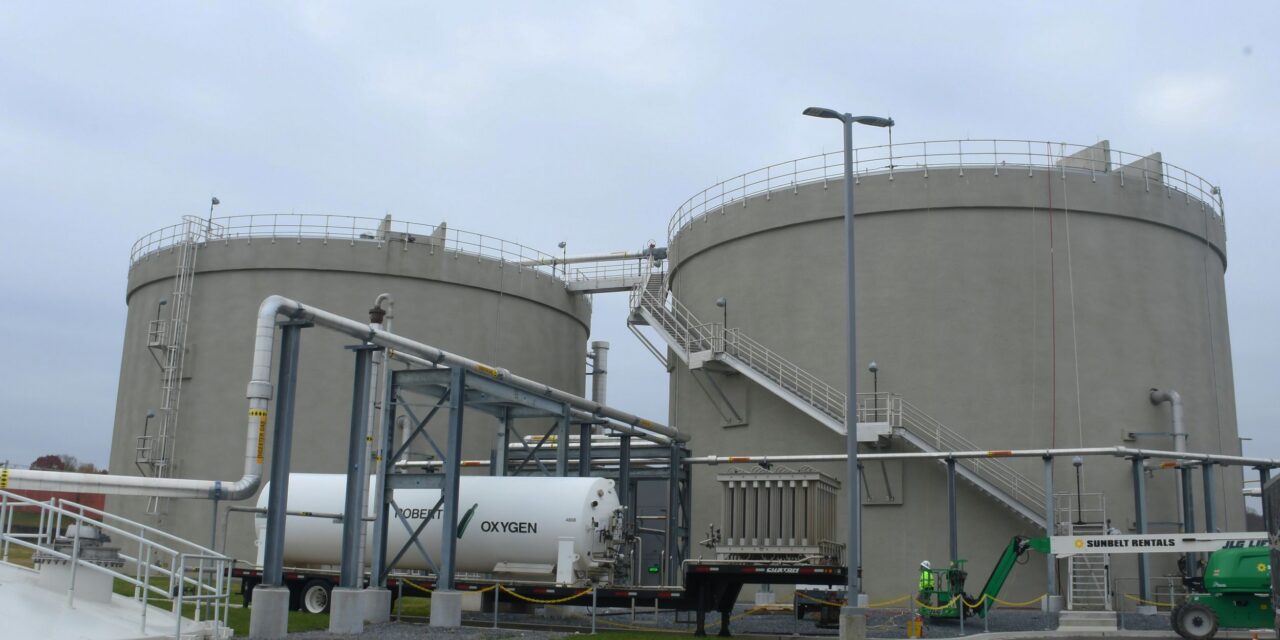
The Washington Suburban Sanitary Commission’s Piscataway Bioenergy Project serves those counties. And the facility in Accokeek turns “poop to power” by converting the methane gas from biosolids — the byproduct of wastewater treatment — into renewable natural gas that helps power Montgomery County’s Ride On public bus system.
The facility uses anaerobic digestion — a process that breaks down organic materials in the absence of oxygen — to capture methane gas, which is then upgraded to renewable natural gas on site.
Of the 16,000 U.S. wastewater treatment plants, more than 1,200 capture biogas from their wastewater sludge using anaerobic digestion. Only 4% of these plants upgrade the biogas to renewable natural gas, according to data from the American Biogas Council. Upgrading to renewable natural gas is the most expensive option.
But renewable natural gas creates an economic incentive to do the right thing for the environment and create better waste handling, said Dylan Chase, senior manager of communications for the Renewable Natural Gas Coalition.
“Out of literal waste, literal human waste, out of poop, you are creating something that can power trucks or heat homes or power ships or other forms of vehicles,” Chase said.
Inside the Piscataway Project
The $271 million Piscataway project, located in southern Prince George’s County, opened in October 2024. The facility began processing biosolids from all six of WSSC Water’s resource recovery facilities last April, according to Brian Mosby, the facility’s biosolids management division manager.
The Piscataway facility also plans to get the certification to classify the leftovers from the treatment process as Class A biosolids to market as soil additives. Class A biosolids are the cleanest form and can be used to improve soil on public sites as well as residential lawns and gardens.
Before the Piscataway Bioenergy Project, all six of WSSC Water’s resource recovery facilities had separate processes for treating biosolids.
“It became obvious to us that we should try to narrow this down and deal with it as a whole, as a company, instead of having all of these different people doing different processes,” Mosby said.
The company sent engineers to observe what some European countries were doing when it came to wastewater treatment, he added. One of the things European experts were implementing was anaerobic digestion.
This process creates a “win-win” situation, said Stephanie Lansing, director of the Bioenergy and Biotechnology Lab at the University of Maryland. She said implementing anaerobic digestion allows for a biocircular economy — one that turns waste into something useful.
A Step Toward Net-Zero Emissions
Limiting the amount of methane-generating waste that enters landfills serves as one part of the Maryland Department of the Environment’s climate pollution reduction plan, which aims for the state to achieve net-zero emissions by 2045.
Methane causes more than a quarter of today’s global warming, according to the Environmental Defense Fund.
The potent greenhouse gas, which is present in wastewater, has more than 80 times the warming power of carbon dioxide in the first two decades it reaches the atmosphere. According to a study from the University of Wisconsin-Madison, urban areas could account for up to nearly a quarter of global methane emissions.
The Piscataway Bioenergy Project is one of the waste-diversion projects meant to assist Maryland in its carbon emission reduction goals.
“Projects like [the Piscataway Bioenergy Project] address emissions in a couple of really important ways,” said Mark Stewart, manager of the Maryland Department of the Environment’s climate change program.
Stewart said sewage is often processed in a way that releases methane into the air, but this project instead captures the methane, cleans it up and puts it into a natural gas pipeline.
Last July, a five-year contract between WSSC Water and Montgomery County went into effect. Under this deal, renewable natural gas from the facility gets sent to Washington Gas, which ensures it meets its standards, according to Mosby.
The gas returns to power the wastewater treatment plant, which gives the facility renewable natural gas credit, Mosby said. Now, the Washington Gas pipeline does not have to power the plant and has more renewable natural gas to power buses.
“It creates an environment where a waste product that is harmful to the environment is captured and reused for transportation,” said Calvin Jones, division chief of fleet management services in Montgomery County.
Approximately 95 Ride On buses in the county were already running on natural gas before this agreement, Jones said, but the deal allows the county to buy the renewable natural gas from the facility at a cheaper rate. This contract is also what creates the market for the facility to create the renewable natural gas, he said.
“If the county did not agree to offtake that renewable natural gas, it wouldn’t be economical for [WSSC Water] to produce it,” Jones said. “Therefore, it would just be waste methane going up into the atmosphere.”
Purchasing renewable natural gas from this facility is in line with Montgomery County’s Zero Emission Bus Transition Plan, which is set to assist the county in achieving zero emissions by 2035. However, the Piscataway agreement is just a step for the county, which plans to transition out of renewable natural gas and electrify its bus fleet by 2033.
While the county may end the use of the renewable natural gas from the facility for its bus fleet, it may extend the contract to continue using the gas in other areas once the agreement expires, Jones said.
A Neighboring Facility
While the Piscataway facility has not operated long enough to demonstrate its impact on the environment, other wastewater treatment plants using anaerobic digestion show benefits.
A decade ago, DC Water’s Blue Plains Advanced Wastewater Treatment Plant in Washington, the largest of its kind in the world, implemented anaerobic digestion. The plant’s process produces gas used to generate more than a quarter of the electricity it needs to operate, said Chris Peot, director of resource recovery of DC Water.
As a result, the facility saw more than a 40% reduction rate in greenhouse gas emissions by the end of 2023. The plant has also reduced its grid electricity purchase by about 30%.
Anaerobic digestion has roughly cut the amount of solids leaving the plant in half since implementation. The facility exports Class A biosolids as a soil additive to farms in Maryland and Virginia.
Before, the plant used to send out 65-70 waste-filled diesel-powered trucks a day, but that number is down to 22-25 trucks of biosolids a day, Peot said.
“We’re not pulling power off the grid, which is generally from fossil fuel gas,” Peot said. “We have reduced the number of trucks on the road, and we’re bringing material out to farmers.”
Cost and Challenges
Despite its long-term benefits, implementing anaerobic digestion and upgrading to renewable natural gas comes with its own challenges.
Changes of temperature, acidity and toxicity levels can slow down or disrupt the treatment process, according to GreenTec Energy, a Singaporean waste management company.
This past winter, a few months after the Piscataway Bioenergy Project’s grand opening, employees had to find solutions to warm the freezing instruments and pipes, according to Mosby. These issues hindered the ability to create Class A biosolids, so part of the equipment had to be shut down.
Above all, high initial costs may be a barrier for facilities to implement anaerobic digestion.
Wastewater treatment plants such as WSSC Water and DC Water initially require hundreds of millions of dollars to implement anaerobic digestion, and the payback period can be many years.
The Piscataway facility is looking at the payback period for the Piscataway Bioenergy Project to be under 20 years, Mosby said
DC Water’s anticipated payback period was expected to be 19 years, Peot said, but the payback is ahead of schedule due to the sale of biosolids. Including the value of the steam generated with waste heat instead of buying natural gas, the facility is looking at a 12½-year payback period.
Benefits associated with implementing anaerobic digestion are worth the millions in investment, according to Patrick Serfass, executive director of the American Biogas Council.
“While you’re making your money back, you’re going to get all these other community benefits on top of it,” Serfass said.
Advantages from anaerobic digesters last for decades after the initial investment is paid back, Serfass added.
A Wider Outlook
The European Union has long known of the advantages of turning waste into energy. There, more than 2,300 biogas plants used sewage sludge in 2023, according to a European Biogas database. This is more than twice the amount in the U.S. Also, 6% of European biogas plants used sewage sludge to upgrade to renewable natural gas.
Europeans are generally more interested in renewable energy and recycling than people in the U.S., Serfass said.
“When you have a society that is motivated to produce renewable energy and also motivated to recycle, it makes it easier to approve investments in the community that helps to do both of those things,” Serfass said.
Overall, there has been a growth in implementing biogas systems to various kinds of facilities, including wastewater treatment plants, for at least the last five years, Serfass said. About 100 new anaerobic digestion projects are coming online every year in the U.S.
Serfass said the American Biogas Council is trying to help people understand how biogas systems work.
“When you tell people that they take organic material and recycle it into renewable energy for homes, vehicles, businesses, and then fertilizer for growing crops and making your garden flourish, I think it’s a really easy thing to get behind,” Serfass said.

Recent Comments