
This column runs in the June issue of The Business Monthly serving Howard and Anne Arundel counties.
“Signs don’t vote,” is an old saying in politics. The candidate with the most road signs doesn’t mean they have the most votes, but they sure help a candidate get noticed.
“Money talks,” is another old saying. The candidate with the most money often wins. But not always. Best example is David Trone who spent a national record $62 million in the Democratic primary in 2024 for Maryland’s Senate seat, only to lose to Angela Alsobrooks.
“Endorsements matter, only when they bring money and manpower,” is another political truism.
By all these standards of conventional wisdom, former delegate and Ways & Means Committee Chair Vanessa Atterbeary is the front runner to be the next Howard County executive.
Atterbeary has the most road signs, huge signs on commercial properties around the county showing her strong support in the developer community. She has the most money, raising over $1.1 million, more than all the other three combined. That’s because the other three have all committed to using public financing where the maximum donation is $300, matched by funding from Howard County taxpayers. Atterbeary has dozens of $6,000 contributions, the maximum legal donation, and scores more of donations of $1,000 or more. Many of the large donations are from developers, builders, businesses and the lobbyists who represent them.
Atterbeary has some of the most prominent endorsements, from Gov. Wes Moore, Alsobrooks, former colleagues in the legislature and the unions for teachers, police and county employees.
She has these advantages in a race to which no one has been paying much attention, particularly the half of registered voters in the county who will have no say in who will be their next county executive. All four candidates for executive are Democrats. There are no Republicans seeking the seat, though Bob Cockey ran twice for the legislature as a Republican. Maryland has a closed primary system, so only the 123,000 registered Democrats can vote in June. The campaigns estimate that only about a third of those Democrats will cast a ballot, maybe 40,000 people in a county of 340,00.
There are no hotly contested statewide or federal races that would stimulate higher turnout. None of the four Democrats running are well-known outside of districts they have represented or run in.
Schools top issue
Education is the top issue for all the candidates. “Our school district is the crown jewel of Howard County,” says Deb Jung, finishing her second term representing west Columbia and Maple Lawn on the County Council. She got into politics eight years ago to funnel more money into the schools.
All the candidates lament that there are over 200 trailers used as classrooms at the county’s 78 public schools. They also are unhappy that the aging school buildings have $192 million in deferred maintenance, a number that doubled in recent years.
It’s among the reasons that Jung opposes spending money on a new central library and a proposed ice rink. Council member Liz Walsh, another executive candidate, says there’s enough money in the county’s accumulating surplus to pay down the school maintenance deficit and build a new central library too.
“Once I started digging into the actual budgets, on the school side, and on the county side,” says Walsh, “it was really clear that, for whatever reason, we were putting this arbitrary limit on schools, both operating and capital budgets and amassing, at the same time, this incredible hoard of cash in our general fund balance.”
This “hoard” is not obvious in the county budget. The county ended fiscal year 2025 with roughly $90 million that its charter requires to be held in the rainy day fund, according to county record. That requirement amounts to 7% of what it spent in the previous year. But the county also had other reserves, including $44 million in a county reserve fund, $38 million unassigned and $12 million earmarked for the next fiscal year’s rainy day fund.
Walsh, who represents Ellicott City and Elkridge, believes the school system has been in decline under the eight years of County Executive Calvin Ball, who was not allowed to run again.
Public campaign financing
Both Jung and Walsh tout their independence through use of public financing, and paint Atterbeary’s fundraising advantage as a liability. “She’s the only one who’s using the kind of business-as-usual financing scheme,” says Walsh. Walsh says in one TV ad that she’s the only candidate not taking contributions from developers and corporations, though that is one of the basic requirements for accepting public financing.
“I’m sick of pay-to-play,” says Jung. Developers expect favorable treatment in return for their donations, she believes, so she has refused developer money from her first run for council. “Fighting for us. Not the special interests,” shouts the cover of one of Jung’s mailers, with the underliner “Publicly financed candidate.”
Jung repeatedly calls it “dark money,” which generally refers to donations to nonprofits where the names of the donors are not revealed. Political candidates in Maryland must list the name and address of donors, but it can be difficult to connect a donor or company to a project they might be interested in.
Atterbeary resents the charge that she’s being bought. “I think it’s offensive to assume that because somebody is not doing public financing, they engage in pay to play. I mean, that’s offensive to my 11-year career in public office. And to be quite honest, I would not have been chair of a committee, vice chair of a committee [Judiciary]. I would not have received the Ethics Ballot endorsement. I would not have gotten the educators’ endorsement. All of the labor unions, the building trades, the carpenters, the painters, and other unions. Those aren’t pay-to play, folks. They are working people, and if you do public financing, you cannot take money from them, and you cannot coordinate with them. I think it’s unfortunate that they’re being characterized as dark money and pay-to-play.”
Jung is also critical of Atterbeary’s role as chair of the committee that passed the Blueprint for Maryland’s Future, the massive package of changes to K-12 education that sought to model Maryland on the most successful programs internationally. Public education here is a state responsibility, but county taxpayers must pick up much of the tab, typically over 50% of a county budget. The Blueprint include higher salaries for teachers, pre-K for low-income students, more vocational education, community schools and many steps along the way.
“It’s not an unfunded mandate,” says Atterbeary. “When I was in the legislature, it was funded through 2028. And certainly, jurisdictions had to fund certain portions of it, but that’s not a surprise to any jurisdiction. I mean, they knew, and folks weren’t happy about it. I’m not saying they welcomed it with open arms. But when I left the legislature, the majority of local jurisdictions were comfortable that they had to fund portion of the Blueprint locally. And that they recognize that this would be significant in terms of better outcomes for the kids in their jurisdiction.”
Bob Cockey, 76, expresses confidence that he can win this race even though he has raised less than $6,000 during the entire campaign. He made a living as a restaurant and bar owner in West Baltimore. Cockey makes much of the fact that the three women running are all lawyers and elected officials who have been responsible for how things have been run in Howard County. “If you like the way things have been going here for the last eight years, vote for one of them.”
MORE INFORMATION ABOUT THE CANDIDATES
WMAR-TV interviewed all four candidates for 15 minutes each
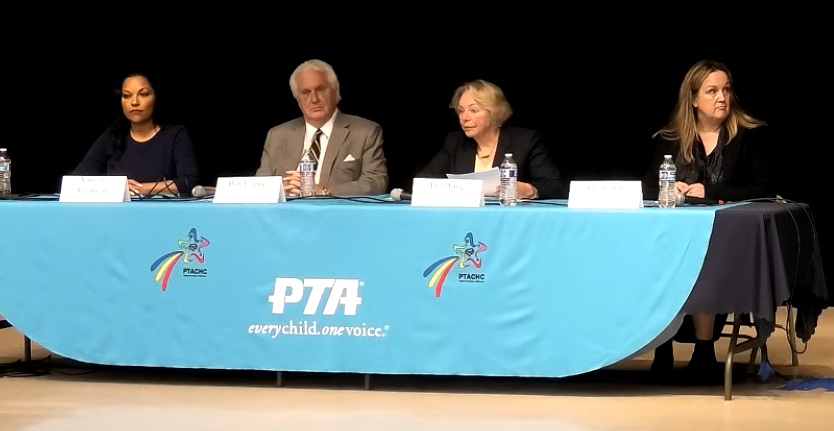
The PTA Council conducted a 80-minute forum with the candidates



Recent Comments