
The following column runs in the March issue of The Business Monthly serving Howard and Anne Arundel counties.
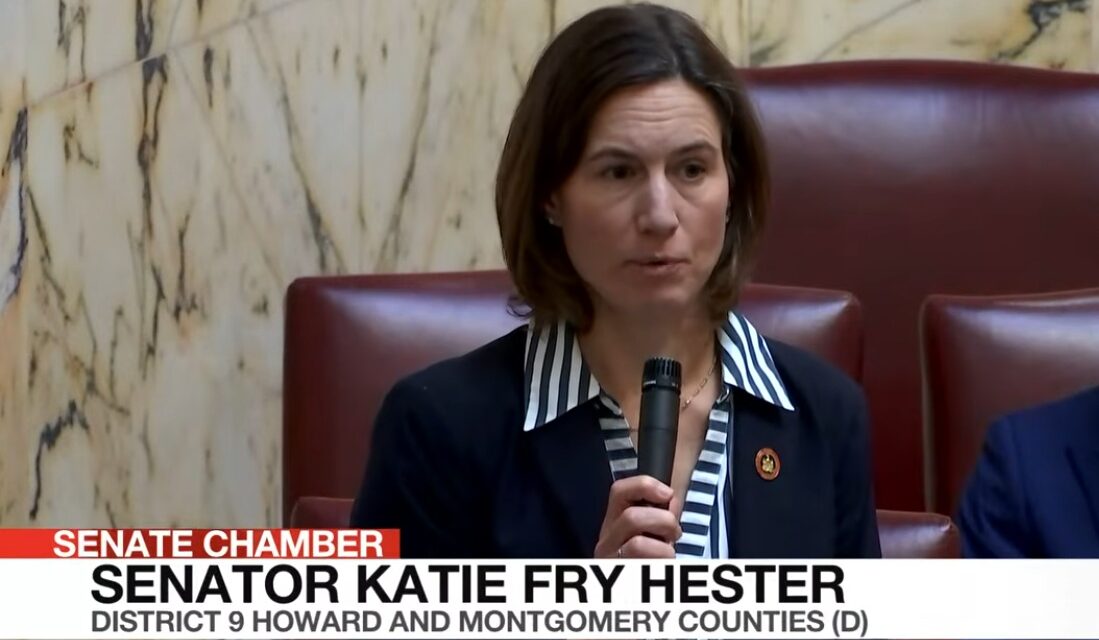
Katie Fry Hester is a busy lady. Many Maryland legislators at this point in their 90-day session have very full days. Hester has an overflowing plate.
The state senator finishing her second four-year term representing western Howard County is lead sponsor on 20 bills dealing with some of the hottest tech issues in Annapolis — electricity rates and supply, artificial intelligence and its ability to do harm and good, data centers that gobble up power, cybersecurity that threatens our privacy and our finances.
Hester is an environmental engineer by training and has worked as an international consultant, so she’s comfortable with wonky in her wheelhouse.
Hester recently got a new side dish on her plate when she was appointed chair of the Senate Rules Committee, a largely administrative panel of legislative leaders that decides whether late-filed bills should get hearings and votes. The House passed congressional redistricting bill to eliminate Maryland’s lone Republican congressman was referred to the committee. But the Rules Committee does not meet unless called by Senate President Bill Ferguson, who firmly opposes any mid-term redistricting. The committee has no plans to meet, Hester says, and most Senate Democrats agree with Ferguson’s opposition to redistricting, she says.
She also chairs the energy subcommittee of the Committee on Education, Energy and the Environment. She is the Senate chair of the Joint Committee on Cybersecurity, Information Technology and Biotechnology, the Senate chair of the Joint Committee on Fair Practices and State Personnel Oversight, and a member of joint committees on audits and the one on legislative ethics, the closed-door panel that handles complaints against lawmakers.
As the saying goes: if you want something done, ask a busy woman to do it.
Hester gets things done. Last session, she was the primary sponsor of 25 bills, most on the subjects mentioned. Half of her bills passed the Senate, 11 passed the House and were sent to Gov. Wes Moore. He signed five and vetoed five for various reasons, mostly because of budget and staffing issues. The Democratic majority in both houses ultimately overrode those vetoes by the Democratic governor.
High electric bills
High utility bills are plaguing all Marylanders, with lots of pressure on lawmakers to “do something.” What can they do?
“Not as much as I wish we could,” says Hester in an interview. “Energy, as you know, is complicated. You’ve got regulators at multiple levels.” Federal, PJM, the operator of the transmission power grid in 13 states, and the states that regulate utilities like BGE through laws and commissions. Hester attended a number of PJM meetings this year where it was estimated that 75% of the increase in electricity demand was due to new data centers whose thousands of servers consume immense amounts of electricity.
“The costs are just so high because we have a national energy shortage” and building new capacity is very slow, Hester says.
“It’s really, really hard to do anything at the state level, which is why we pushed PJM to say, if we’re gonna allow these data centers to connect, make sure they pay their own fair share of the load and they assume the risk if somebody has to get turned off because we’re gonna have a rolling blackout, let’s turn off the data centers first.” PJM announced in January it wanted to do that.
One Hester bill that nibbles around the edges of high electric bills, SB2, prohibits the use of rate payer dollars to give multimillion-dollar bonuses to utility executives the way they’ve gotten recently. It may only shave a few dollars off of monthly consumer bills, but the House version of the bill has already passed.
Artificial intelligence
One of the big drivers of the increased demand for data centers is the boom in artificial intelligence which eats lots of power. As with any new technology with unknown implications, government is often slow to respond.
One Hester bill establishes civil and criminal penalties for using AI to spread misinformation and disinformation about elections, including deepfakes – making it appear someone said or did something they didn’t. That bill passed the Senate unanimously. Another bill makes it a crime to use the same AI techniques to create identity fraud.
She also has a couple bills “that are looking at the growth potential and how AI can help the economy.” One is the AI Ready Schools Act about teaching kids effectively.
“If you look at what employers are looking for right now, they want to be hiring kids who know how to use AI but also know how to critically think.”
States like Maryland are taking their own steps to regulate artificial intelligence because the federal government has failed to do so. “At the congressional level, they still haven’t passed a data privacy law,” notes Hester, Not only haven’t they passed AI regulations, she says, the Trump administration is going the opposite direction, trying to pre-empt states from passing their own laws on AI.
She serves on a large bipartisan task force of state legislators on AI and cybersecurity, “We are half Republican and half Democrat, and we all agree that states should have rights and we all agree that AI needs to be regulated. We’re all trying to pass the same type of bills and I think we would all just love to have the federal government do something.”
Running again
On top of all Hester’s other duties, she’s got a reelection campaign to run. UPDATED 3-1-2026 She has no opponent in the Democrat primary, but unlike her two Howard County colleagues who have free rides to re-election, she does have a Republican challenger.
Just 12 years ago, legislative District 9 was represented by four incumbent Republicans, a senator and three delegates. In 2018, to the surprise of many, Hester beat Republican Senator and long-time Del. Gail Bates by 1000 votes, and former County Council member Courtney Watson, D, defeated long-time Republican Del. Bob Flanagan in single member district 9A. Four years later, after the legislature removed the portion of staunchly Republican Carroll County and added a slice of Montgomery County, Hester won the district by 9,000 votes and all the delegates elected were Democrats. She also got substantial financial help from the Senate Democratic campaign.
“When I ran and won the first time, it was 40% Republican. And then half of those Republicans defected to become independents. My district is now, like, 40% independent. 40% Democratic and 20% Republican.”
“The whole reason I ran was because I was so worried about Trump in 2016. That was my impetus — to protect the state, make sure that we have strong state standing if the federal government goes haywire. Little did I know how crazy it was gonna be in 2025 and 2026. But all of my [Democratic] colleagues, we’re all united in feeling that the federal overreach is horrible, and the impact on Maryland is really acute. The administration is lawless, and we’re going down the road of fascism and dictatorship.”


Recent Comments