
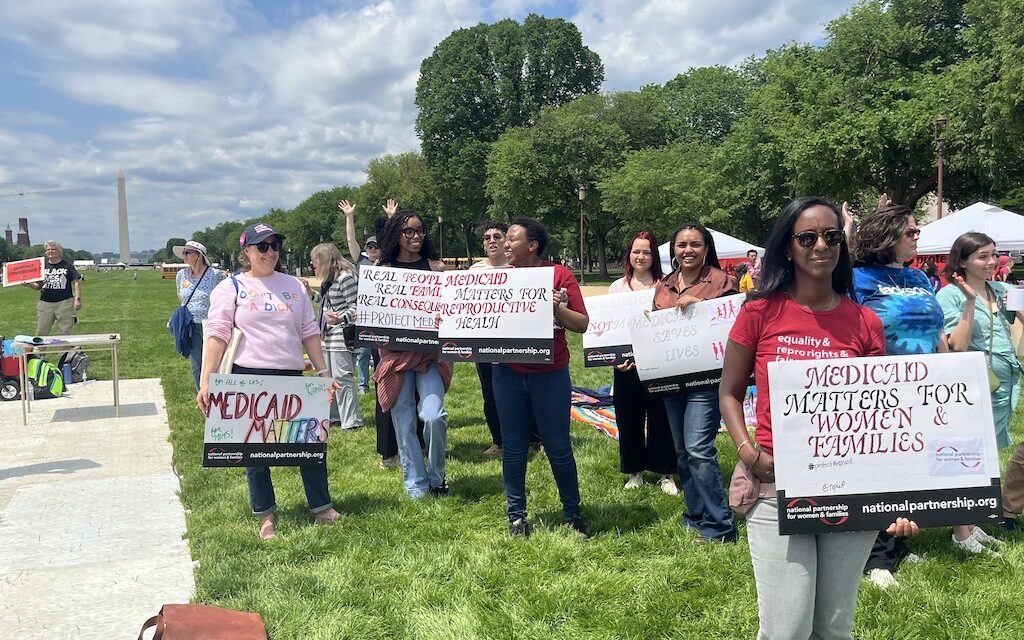

Three months later, new work and renewal requirements will affect about 320,000 low-income Maryland adults who qualify for Medicaid under the Affordable Care Act, with state health officials projecting that about 152,000 could lose coverage by June 2028.
Signed by President Donald Trump on July 4, 2025, the law is expected to cut federal spending by more than $900 billion through 2034 for the jointly funded federal-state program that helps people with low incomes or disabilities pay for health care. Announcing the signing that day, the White House said the law would strengthen the program by “eliminating waste, fraud and abuse and blocking illegal immigrants from receiving Medicaid.”
People living in the country without authorization have long been ineligible for Medicaid that is funded by federal and state dollars. The new law, however, affects coverage for immigrants living here legally and for low-income adults, including many U.S. citizens.
“The law passed and we have to stay in compliance with the law,” Maryland Health Secretary Meena Seshamani told Capital News Service.
But Seshamani said she is deeply concerned. “When people lose their health insurance, they’re not able to go see a doctor when they get sick… and the downstream impact of that on the lives of people in our community and their families is really, really, really concerning.”
Seshamani said that the Maryland Health Department is doing what it can to protect Marylanders and help them maintain access to healthcare.
October: Certain immigrants lose Medicaid
The Oct. 1 cutoff ends full Medicaid eligibility for certain lawfully-present adults: refugees, asylees, people granted temporary humanitarian permission to enter or remain in the U.S. for at least a year – including some Afghans and Ukrainians – and certain abuse or trafficking survivors, the health department said.
Green card holders who meet or are exempt from a five-year waiting period, Cuban and Haitian entrants and migrants covered by the Compacts of Free Association can still qualify.
Children and pregnant women will keep their coverage and emergency care remains unaffected, the health department said.
About 4,500 enrollees received notices in August that their full Medicaid coverage would end, health department spokesperson Amanda Hils said.
The department did not provide a county breakdown, saying it is still confirming where the affected enrollees live.
Nina Ashford, Montgomery County’s chief of public health services, said that because of its large immigrant population, the changes could leave Maryland’s most diverse county disproportionately affected.
“I think the situation is terrible and cruel, to put it lightly,” Ashford said, adding its effects would fall hardest on “our lower-income residents and immigrant communities.”
Many Prince George’s County residents have brought Medicaid notices to the Health Department for review by an enrollment specialist. Some have disenrolled before Oct. 1, expecting to lose coverage, said Andrew Ballard, the department’s chief of public health policy and innovation.
“When a resident loses Medicaid, care typically shifts or in some instances stops altogether,” Ballard said.
Patients may go without prescriptions or treatment for chronic conditions, behavioral health needs and other specialist care, he said, with some routine needs later surfacing in emergency departments.
Some affected immigrants may qualify for financial help buying a plan through Maryland Health Connection for the rest of 2026.
But a separate restriction taking effect on Jan. 1, 2027 will limit that assistance to lawful permanent residents, Cuban and Haitian entrants, and migrants covered by the Compacts of Free Association, Hils said.
January: Work rules and twice-yearly renewals
Another, much broader change also begins on Jan. 1. Low-income Maryland adults ages 19 to 64 who qualify for Medicaid through the ACA will face new federal work requirements and have to renew their coverage every six months instead of once a year.
In Maryland, this coverage generally extends to adults earning up to 138% of the federal poverty level – about $22,000 a year for one person.
This group makes up about 22% of the state’s roughly 1.5 million Medicaid enrollees.
They can meet the new rules by earning at least $580 a month, attending school at least half-time or completing 80 hours a month of qualifying work, training or volunteering.
Exemptions include pregnancy, caring for a child younger than 14 or a person with a disability, and being deemed “medically frail.”
Existing enrollees will face the work checks when they renew in 2027, according to Maryland Health Connection.
If the state cannot verify compliance or an exemption, federal rules require a notice and 30 days to respond before coverage is denied or ended.
County health officials fear some adults who remain eligible will nevertheless lose coverage because they cannot navigate the new requirements and will be lost in the process.
“Not because they’re no longer eligible for Medicaid, but because they can’t figure out the paperwork,” Ashford said.
A 2019 study of Arkansas’ earlier Medicaid work requirement found significant coverage losses in its first six months without a significant increase in employment.
Maryland raised its projected coverage losses from 115,000 to 152,000 after federal regulators issued an interim final rule in June.
Attorney General Anthony Brown joined a multistate lawsuit challenging parts of the rule, arguing that the federal government unlawfully narrowed protections for medically frail people.
An Urban Institute analysis projects the work and renewal rules could leave 102,000 to 207,000 fewer Maryland adults enrolled in an average month in 2028, depending on how aggressively the state implements them. Nationwide, their projection shows 4.9 million to 10.1 million fewer enrollees.
Seshamani said Maryland is automating eligibility checks and working with navigators, community groups and faith organizations to help residents.
Meanwhile, another Jan. 1 change limits Medicaid’s coverage of bills incurred before enrollment from three months to one for ACA expansion adults and two for other enrollees.
“This is actually really important because this could saddle folks who are eligible for Medicaid with massive amounts of debt,” Ashford said.
Who pays when coverage ends
Vincent DeMarco, president of the Maryland Health Care for All Coalition, warned that coverage losses could raise costs for people who remain insured.
“We all benefit from this health care coverage,” he said. Without it, he said, more people could turn to hospitals, raising uncompensated care costs and premiums.
DeMarco said state lawmakers will have to raise more money for health care. His coalition’s five-point plan includes a proposed 10-cent-per-drink increase in the alcohol tax, which he said could raise nearly $220 million.
Seshamani said the state has a $25 million fund for federally qualified health centers so people who lose insurance will still have a place to seek care.
Montgomery County is preparing to serve more residents through Montgomery Cares and Care for Kids, Ashford said. In Prince George’s County, uninsured residents can seek care at federally qualified health centers, reproductive health and HIV/STI clinics and behavioral health services, Ballard said.
These programs, however, have finite capacity.
“None of this is a substitute for continuous coverage and each piece of this patchwork has its own capacity limits and funding exposure,” Ballard said.


Recent Comments