
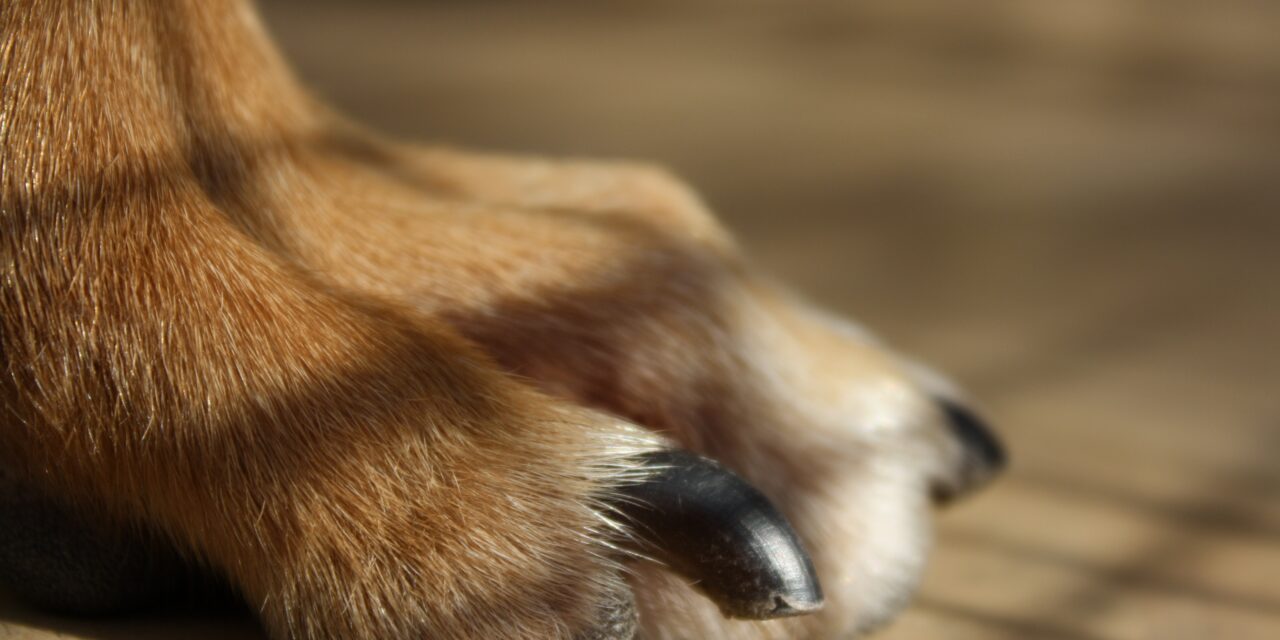
If you can hear your dog’s nails clicking across a hard floor, they’re likely longer than they should be. That sound means the nail strikes the tile before the pad, which can affect your dog’s traction, posture, and long-term mobility.
Nail length is often treated as a grooming detail, but outgrown nails can change how your dog carries their weight, and years of standing that way add up. Here’s a quick guide to what long nails do to the foot, how short nails should be, and tips for the pups who dislike having their feet handled.
What Happens When Nails are Outgrown
In most cases, a dog’s nails should clear the floor when they stand on a flat surface, then come into play for traction on a hill or a turn. When a dog’s nails hit the ground first, every step has the potential to push it back into the nail bed.
Before long, that pressure travels into the toe joint, and dogs respond the way you would with a stone in your shoe. They shift their weight backward, off the toes and onto the rear of the foot. Doing this for years can add extra loading through their wrists, elbows, and hips.
Where the Slipping Comes From
The pad grips the floor, and a nail landing ahead of it lifts that pad slightly off the surface. On hardwood or tile, your dog ends up scrabbling for purchase on the one part of the foot that has none.
Runners along the routes your dog uses most will help, though the nails are the part you can fix at the source. A senior who slips once often starts bracing against it, and that guarding changes how they move long after the floor stopped being the problem.
How Short Is Short Enough
Inside each nail is the quick, a bundle of blood vessels and nerves. Cutting into it hurts and bleeds, which is what makes everyone nervous.
The quick grows out along with the nail, so a dog whose nails have been long for a year has a long quick to match. You can’t get to a good length in one session. Take a small amount off every week or two and the quick recedes, giving you room to work within a couple of months.
Light-colored nails make this easy, since the pink of the quick shows through. With dark nails, take thin slices and watch for a pale oval in the cut surface, which tells you to stop.
Tips for Dogs Who Don’t Like Trimming
Some dogs are just fine with foot handling, while others will fight it. Maybe a past trimming went wrong and hit the quick, causing your dog to pull its paw back for years. Conditioning is one of the first ways to rebuild trust and comfort with nail trimming.
Start by touching a paw and giving a treat, with no clippers in sight, then work up to holding the paw, letting your dog see the clippers, and finally one nail per session. Especially for food-motivated pups, getting a piece of chicken after every nail changes their mind within a few weeks. And for the pups that need extra calming support, you may want to add fast-acting calming chews to their trimming routine.
If it’s more about the tool, a grinder suits some dogs better than clippers, since there’s no pinch once they’re used to the hum, and scratch boards let a dog file their own front nails against angled sandpaper.
In the end, if it’s just not working at home, your vet or groomer can also do the job in a few minutes.
Don’t Forget the Dewclaws
Dewclaws sit up on the inside of the leg and never touch the ground, so they never wear down. Be sure to check these every time you trim. Left alone, they can curl around and grow into the pad, snag, and break, all of which can be painful for your pup.
Older dogs need trimming more often than they used to, not less. A senior who walks a mile a day on grass instead of three on pavement isn’t wearing anything down, and stiff joints make long nails harder to compensate for.
Worth Doing This Week
Breed and genetics decide a lot about how a dog moves at ten years old, and there’s nothing you can do about either one. Nail length is one of the few things you actually control, and all it costs is picking up the clippers on a Sunday.
And if the clicking has been going on for a while, or your dog won’t tolerate clippers at all, a vet or groomer can get it back to a good length and set you up with a schedule to keep it that way.




Recent Comments