

Most people who look for a clinical trial give up at the same point. They search for their condition, find that the studies nearby are either full or not yet open, close the tab, and never check again. The trial they needed often does open, sometimes only a few weeks later. They just never hear about it. Timing, not eligibility, is what quietly knocks most people out of clinical research.
This is the exact gap Hipa.ai was built to close. When you find a study on Hipa.ai that fits but has not opened yet, you do not have to keep coming back to check on it. The study page carries a “Notify me” option. You leave your details once, Hipa.ai ties them to that specific study, and the moment recruitment opens it emails you automatically so you can move while the cohort is still wide open. No re-searching, no refreshing the page every week, no missing the narrow window before a study fills.
It sounds like a small thing. It is not. For a patient tracking a specific diagnosis, the difference between learning about a study on day one and stumbling onto it after enrollment closed can be the difference between getting in and waiting another year for the next one.
Why timing is the hardest part of finding a trial
A clinical trial does not remain open indefinitely. It registers, waits, opens recruitment, fills its target number of participants, and closes. That whole arc can run for years or, for a small early-phase study, a matter of weeks. The registry tracks every stage with a status field: not yet recruiting, recruiting, enrolling by invitation, active but no longer recruiting, completed.
The studies that matter to you are usually the ones not yet open. A trial marked “not yet recruiting” is registered and funded, but has not started taking people. If you search today, it shows up as unavailable, so you move on. Then it opens next month and you have no idea, because nothing told you. The system has no built-in way to tap you on the shoulder. That is the structural flaw Hipa.ai set out to fix: turning a database you have to keep checking into a service that reaches out to you.
The people who manage to enroll in the trial they wanted are almost always the ones who caught it early. They knew the study was coming, or they happened to look at the right time. Everyone else is relying on luck. Alerts replace luck with a system.
How Hipa.ai’s recruiting alerts actually work
The mechanism is straightforward, which is the point. Say you are looking through paid clinical trials near you and you find one that fits, but its status reads “not yet recruiting.” On most sites, that is a dead end. On Hipa.ai, that study page shows a “Notify me when recruiting opens” panel. You click it and join the interest list for that study.
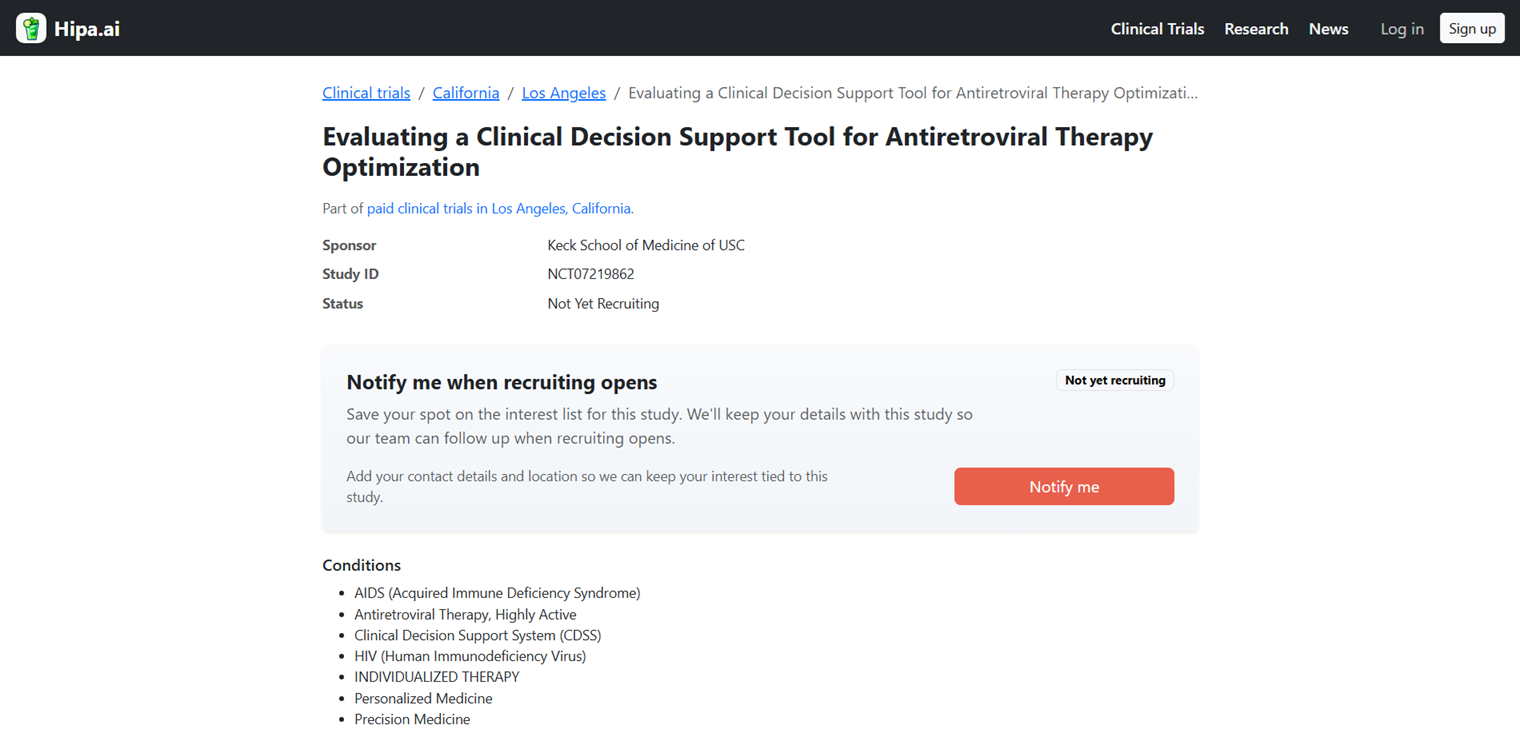
From there, Hipa.ai watches that study for you. Because Hipa.ai rebuilds its index from ClinicalTrials.gov every week, it catches the status change shortly after the sponsor reports it, and the system automatically emails everyone on that study’s interest list the moment recruitment opens. Nobody has to remember to check, and nothing depends on you looking again. You hear about the opening while the cohort is still wide open, not after it has filled.
This has already played out in practice. People save their spot on a study that has not started yet, the trial flips into active recruiting, and Hipa.ai emails them automatically the moment it does. It is a simple loop, and the point is that it runs on its own. Instead of you checking a federal database over and over, hoping to catch the day a study opens, you raise your hand once and the engine does the watching from there.
What makes this different from a normal directory
Plenty of sites will show you a list of trials. Almost none of them will tell you when that list changes in a way that matters to you. That is the line between a directory and a discovery engine, and it is where Hipa.ai is built differently.
A static directory is a snapshot. It is only as good as the day you happened to look at it, and clinical trials change too fast for any single look to be reliable. Hipa.ai treats the data as a live feed instead of a snapshot. Because it refreshes weekly and tracks recruiting status across more than twenty-seven thousand active studies in all fifty states, it can do something a static list cannot: catch the moment a study you already flagged goes from “not yet recruiting” to open, and make sure the people waiting on it actually hear about it.
The coverage matters as much as the automation. A directory that only watches a couple of cities leaves most of the country with nothing to flag in the first place. Hipa.ai indexes every state, so someone in a smaller market can save their spot on a study just as easily as someone in a major research hub, and the same automatic alert reaches them when it opens. And because Hipa.ai links straight to the sponsor’s own contact details from the registry, none of this hides the trial behind a wall. The listings are open, the contacts are public, and the interest list is simply there for the studies that have not opened yet. The data is never gated, so you own the conversation from the first message.
How to save your spot
If you find a study that fits but it has not opened yet, the practical move is to stop checking back and join its interest list instead. On the study page, click “Notify me when recruiting opens,” fill in your name, email, phone, and location, add a note about your availability if it helps, and submit. You will see a confirmation that your details are saved with that study, and that is it. When recruitment opens, the email arrives on its own.
It costs nothing, because Hipa.ai is free for participants. There is no reason to keep a browser tab open or to set yourself a reminder to re-check a registry you find hard to read. The whole point of saving your spot is that it removes the need to remember. You raise your hand once and Hipa.ai carries the watching from there.
The takeaway
The hardest part of joining a clinical trial is almost never qualifying. It is being there at the right moment, in the short window between a study opening and a study filling. Hipa.ai exists to make sure you are. By tracking recruiting status every week and emailing you automatically the moment a study you saved opens, it turns a system you would otherwise have to chase into one that comes to you on its own. For anyone serious about finding a study, that is the difference between hoping you catch it and knowing you will,




Recent Comments