
This column appears in the September issue of The Business Monthly serving Howard and Anne Arundel counties.
8:45 a.m. on a Saturday morning in the resort town of Ocean City. Not a fishing trip, not an early day at the beach or a time to sleep in after a late night out.
In a windowless room in a chilly convention center over 100 mostly local officials at the Maryland Association of Counties annual seaside conference gathered to hear state leaders talk about the biggest spending issue on everyone’s plate – the increasing cost of the Blueprint for Maryland’s Future, the massive education reform package.
“We are in a worldwide competition,” said Ike Legett, the former Montgomery County Executive who now chairs the Blueprint Accountability and Implementation Board. He had just visited Singapore, one of the model school systems for the commission that created the Blueprint.
“This is not, it should not be, one size fits all. But we have to keep in mind why we are doing it. And we are making progress [on student achievement].”
“We have to slow [implementation] down, OK, but we have to get it through,” said Leggett.
Next to him on the panel was Carey Wright, the state superintendent of schools, who emphasized the importance of early childhood education and the need to get students reading by third grade. Before Wright, a Prince George’s County native, became superintendent three years ago, she spent nine years as superintendent in Mississippi where she engineered the reforms that led to the fastest improvement in math and literacy scores in the country.
The state and its counties spend $10 billion on public schools, with a billion of that going for special education. The Blueprint encouraged the formation of “community schools,” with wraparound social services for students and families. About half of Maryland’s 1400 public schools are now “community schools,” Wright said.
“We still have an issue with teacher shortage,” she said. Maryland has always had to import teachers educated in other states. Maryland still has too many uncertified teachers and there is the continuing problem of getting its best certified teachers into the state’s worst performing schools.
One of the key Blueprint goals was to make teaching more attractive as a profession, by treating them as well-paid professionals. As an initial step, school systems were to raise starting salaries to $60,000, which most have been able to do.
In the trenches
Down in the trenches, Jeffrey Lawson has a different point of view. He has been superintendent of mostly rural Cecil County on the borders of Pennsylvania and Delaware for eight years – a relatively long tenure as the job goes — and was Superintendent of the Year in 2025. There are 14,000 students in his district.
Lawson put up a chart on a screen that looked like a detailed spread sheet. It was a list of the categories of spending in the Blueprint, among them: multilingual learners, special education, and “compensatory education,” “a fancy way of saying poverty.” The spread sheet mapped out rising costs for each category over the next nine years and includes “collaborative” teaching time for some of them, one of the elements of enhancing teaching as a profession.
“Here’s the problem with the Blueprint. You can make a strong case for every one of these rows. I think we can all agree that the kids coming from poverty, they need more. They simply do.”
“We can all make a compelling case for each of these rows. In totality, the Blueprint comes across as a little overwhelming from a financial perspective, and that’s where the bulk of officials get stuck in this ditch. We can’t continue to spend this kind of line.”
“Even your more experienced legislators oftentimes aren’t aware of this level of detail behind these numbers.” In the call for savings, “eventually they’re going to have to winnow down these rows.”
Commissioner Jack Wilson of Queen Anne’s County, a Republican, made a similar case about rising costs from a local government point of view. County governments cover almost half of spending on public schools.
He agreed that “this concentration on this topic of early education within the Blueprint is essential to move the whole thing forward.”
“But at the end of the day, what we’re finding is on the budgetary side of it is specifically the uncertainty.” He cited one recent example where school officials in his county were asked what they needed for an item the following year, and they answered $6.3 million. But the budget they eventually submitted actually asked for $13.9 million. “We have a lot of things we got to spend money on” and an extra $7 million in a $180 million county budget is ‘big.’”
One of the questions from the audience came from Jessica Nichols, newly elected to the Howard County Council and a former Teacher of the Year, spending eight years teaching social studies at River Hill High School.
“What can we do to maintain moving the Blueprint forward but also understanding that in counties like mine, like Howard County, we are going to be hammered disproportionately with obligations because we don’t get the poverty differential?,” she asked. Nichols really didn’t get an answer from the panel.
The panel itself, moderated by Senate President Pro-tem Malcolm Augustine, D-Prince George’s, was an example of one of the weaknesses of the Blueprint compared to the top-down command structure of education in countries like Singapore. Maryland has a very fragmented system of governance. The Accountability and Implementation shares authority with the State Board of Education, which hires Wright and shares some authority over the local boards and the superintendents they hire. The legislature controls the state spending but county governments pay for almost half of school funding yet have limited say over how the money is spent.
Not a junket for most
The annual MACo conference attended by over 850 county officials may look like a taxpayer paid junket — and for some it probably is. But for most it’s an opportunity to interact with others facing similar problems and issues. It’s also a chance to meet in casual settings with the governor and members of his cabinet and other state leaders like Leggett and Wright.
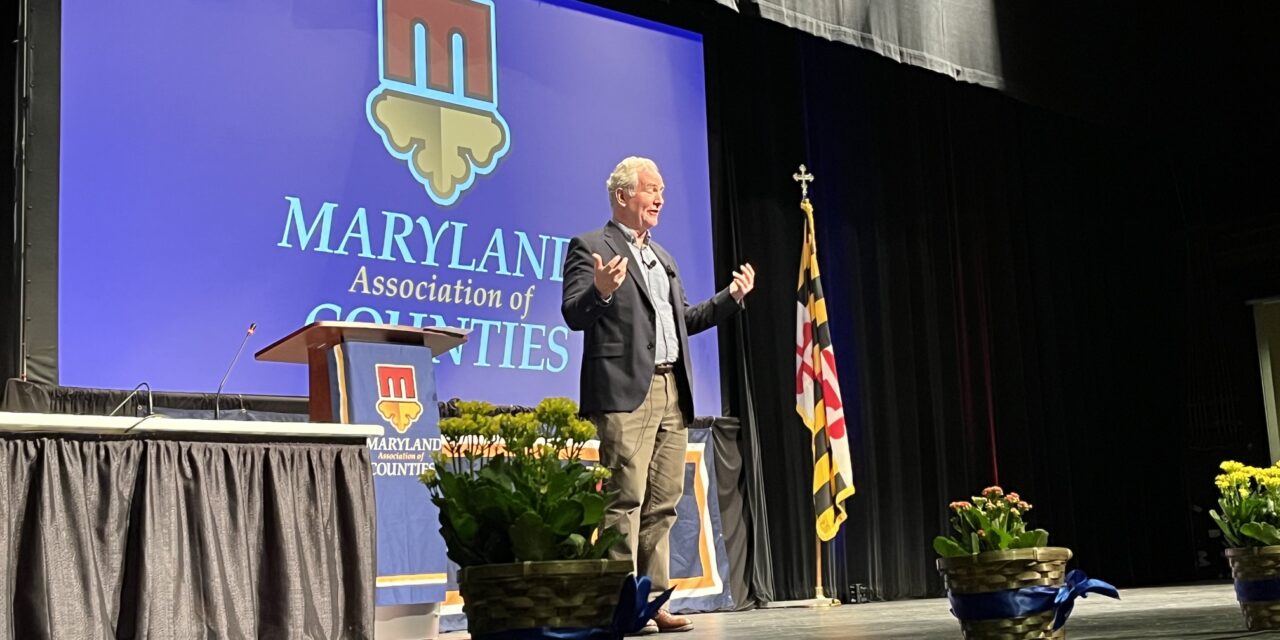
Coming out of a well-attended session with U.S. Sen. Chris Van Hollen on federal issues, I ran into Kumar Barve, a former House of Delegates committee chair who now chairs the state Public Service Commission which regulates utilities. I got a quick briefing on electric rates and data centers from an expert I was unlikely to see in another setting. Ditto Jake Weissmann, former top aide to the late Senate President Mike Miller who now is Gov. Wes Moore’s budget secretary. “We will have a balanced budget” come January, Weissman assured me. “We have no choice.”
Then there was the governor himself, doing the traditional walk-through of the mammoth exhibit hall. He was surrounded by a moving scrum of exhibitors and attendees for brief chats and quick selfies. But he had also attended closed private sessions with top county officials.
It’s not a day at the beach. My bathing suit never got wet.



Recent Comments