
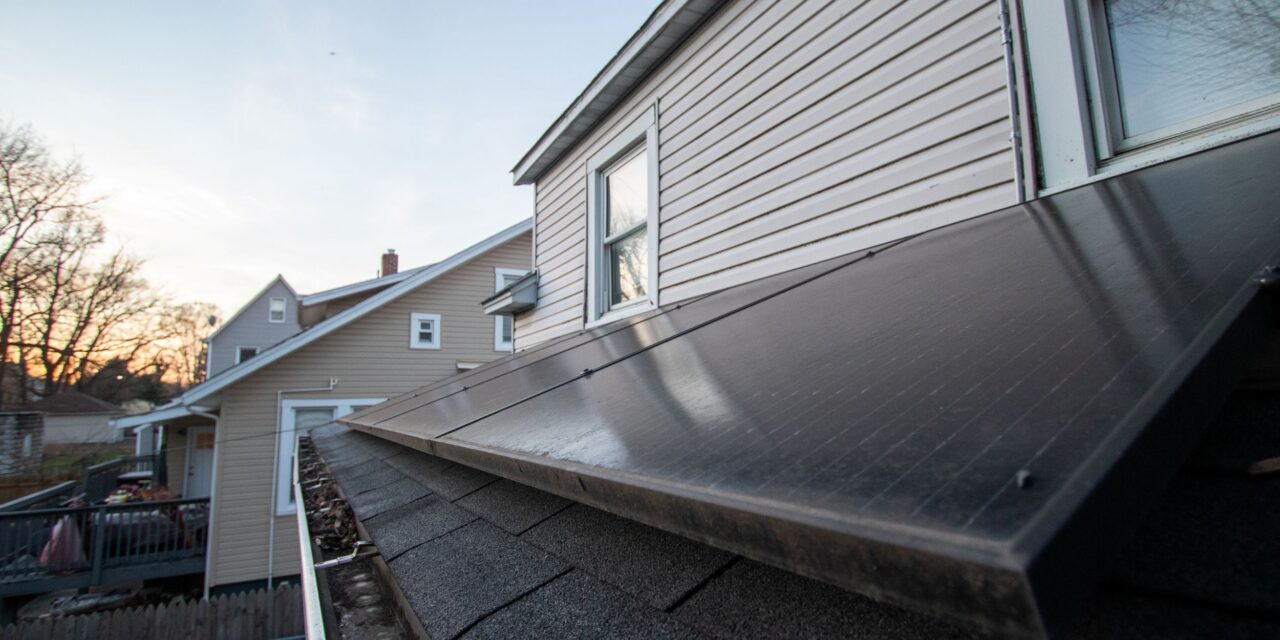
Maryland entered 2026 with new residential solar rules after the federal 30% residential credit ended and the state moved forward with plug-in solar, income-based grants, and HOA review standards. Below, we break down the Utility RELIEF Act, the federal credit cutoff, MSAP grants, HOA solar rights, and the main rules that affect residential solar decisions.
The Utility RELIEF Act and Balcony Solar
The Utility RELIEF Act, signed as Chapter 353 on May 12, 2026, covers several energy issues, but its most visible solar provision for residents is portable solar. The law defines a portable solar energy generating system as a movable photovoltaic device connected through a standard outlet and used mainly to offset part of a building’s electricity use.
For homeowners and renters, balcony solar means a small plug-in setup that can support part of the daytime household demand without a full rooftop installation. Under the portable solar provisions discussed in the Act, these systems are limited to 1,200 watts back to the building’s electrical system and one portable solar system per residential electric meter. The customer must notify the electric company before installation and provide certification of safety features and maximum generating capacity. The utility may not require prior approval or charge a fee for sending electricity back into the building’s electrical system.
What Replaced the Federal Solar Tax Credit
The federal Residential Clean Energy Credit was the largest single incentive for many homeowners. It covered 30% of the eligible residential clean energy costs. IRS guidance now states that the credit is not available for property placed in service after December 31, 2025. The related Section 25D guidance also refers to the cutoff for expenditures made after that date. A 2026 solar project owned by the homeowner no longer qualifies unless the qualifying work was completed within the 2025 window.
The state’s response was targeted. MEA created the FY26 Solar Access Bridge Fund as a one-time financial assistance program for qualifying MSAP applicants affected by the early phase-out of the federal credit. With incentives shifting rapidly, homeowners have been turning to resources like Maryland Solar Guide to understand what programs are still active and how costs have changed heading into 2026.
The Bridge Fund was built around projects already moving through MSAP. MEA listed these core conditions:
- MSAP application between July 1, 2025, and November 30, 2025;
- Installation completed between January 1, 2026, and May 30, 2026;
- Utility permission to operate;
- No federal Residential Clean Energy Credit claim for the same system;
- Household ownership through cash purchase or loan financing, not a lease or power purchase agreement.
Bridge Fund grants were calculated at $1,000 per kW of installed solar capacity, up to $15,000, or up to the customer’s remaining net project cost (if that cost was below $15,000). The deadline was May 31, 2026 (or until budgeted funding was exhausted).
MSAP Grants: Who Qualifies and How the Money Works
The Maryland Solar Access Program remains the main state grant program for income-qualified residential solar. FY26 MSAP is noncompetitive and distributes funds on a first-come, first-served basis. The process has two steps: an initial application to reserve money and a completion verification after installation.
For FY26, MSAP grants are available to Maryland residents whose annual household income fits the program’s household-size limits. The income range runs from $136,785 for a 1-person household to $257,910 for an 8-person household. The application portal closed to new applications on April 17, 2026, after funding requests exceeded the $12 million FY26 budget.
MSAP provides $750 per kWDC, with a maximum grant of $7,500 per home. The system must be installed on a residential property in Maryland, and the grant must be reserved before the project moves to completion verification.
HOA Solar Rights Under Maryland Real Property Code §2-119
Maryland Real Property Code §2-119 gives homeowners measurable protection against HOA and condominium restrictions on solar collector systems. A restriction is unreasonable if it increases installation cost by at least 5% over the initially proposed installation or reduces projected energy generation by at least 10%. The protection applies to roofs or exterior walls when the property owner owns those surfaces or has the right to exclusive use.
The statute gives associations a clear review role. To challenge a restriction, the homeowner must submit documents from an independent solar panel design specialist. That specialist needs NABCEP certification. Alternatively, they may file an affidavit showing at least 30 solar collector system designs in the past three years. Associations may still limit systems in common areas or common elements (especially in condos and some townhome communities).
A Bottom Line for 2026
Maryland homeowners now deal with separate rules for rooftop ownership, state grant timing, portable systems, utility notice, and HOA review. Rooftop solar depends on grant timing, income eligibility, ownership structure, interconnection status, and HOA documentation. Portable solar and the Bridge Fund add narrower paths under defined state rules.




Recent Comments